
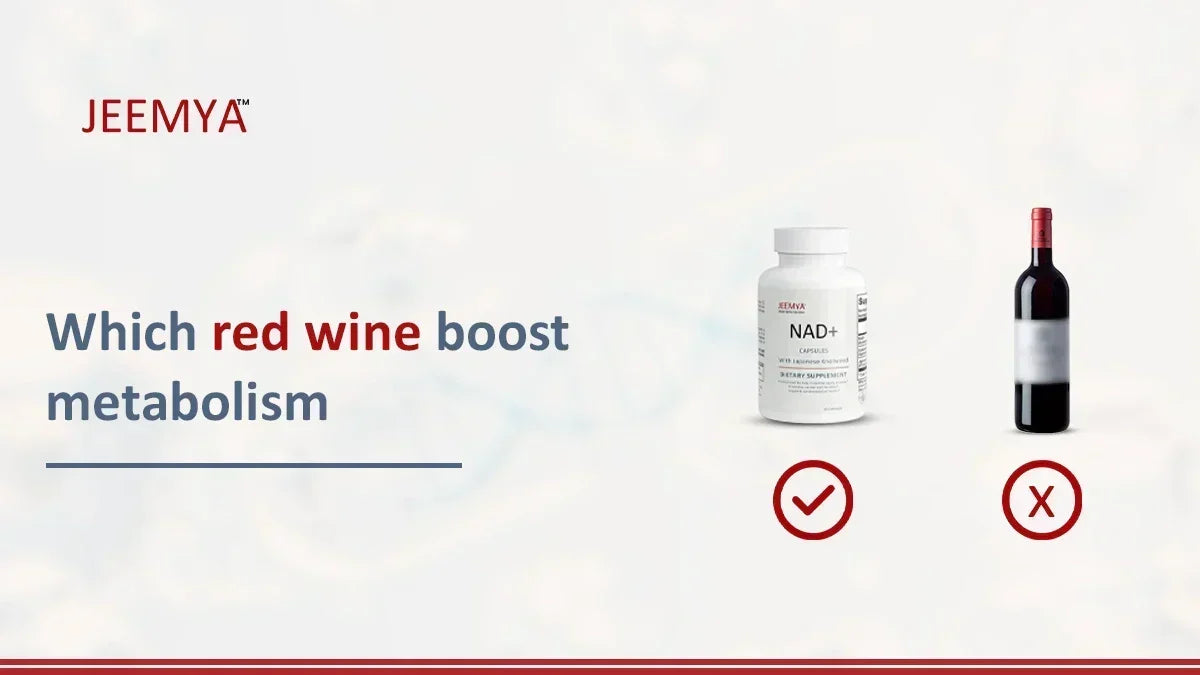
You've probably heard it before "a glass of red wine a night is good for you." But is there any truth to the idea that red wine can actually boost your metabolism? And if so, which red wine should you choose?
The answer is more nuanced than the headlines suggest. Yes, red wine contains a remarkable compound called resveratrol, a natural polyphenol found in grape skins with genuinely exciting science behind it. But between wine and your metabolism, there's a critical gap that researchers have been studying for decades.
In this article, we'll walk through what the science actually says, which red wine contains the most resveratrol, and why many adults over 40 are turning to high-potency resveratrol supplements and NAD+ stacks to get the cellular benefits without the drawbacks of alcohol.
Can Red Wine Actually Boost Metabolism?
Let's be direct: drinking red wine is not a proven strategy to boost your metabolism.
While red wine does contain resveratrol, the actual concentration in a glass of wine is extremely low. According to research reviewed against NIH standards, achieving the resveratrol doses studied in clinical trials would require consuming an impractical and medically dangerous quantity of wine daily.
Here's what the science does show:
- A 12-week randomized trial in healthy adult males found no significant differences in body weight, body fat percentage, or resting metabolic rate between those who consumed two glasses of red wine daily versus those who abstained
- A 2-year randomized controlled trial in adults with type 2 diabetes, found no significant differences in weight loss or abdominal fat between groups consuming red wine, white wine, or mineral water
- Excessive alcohol consumption is well-documented to promote weight gain, increase liver fat, and raise cancer risk, directly countering any potential benefit from resveratrol's trace presence in wine
The takeaway: The metabolic compounds in red wine are real and worth understanding. The wine itself, however, is not the delivery vehicle science recommends.
Why Some People Believe Red Wine Supports Metabolic Health
The belief didn't come from nowhere. Red wine contains a broad spectrum of polyphenols and antioxidants — particularly resveratrol, quercetin, and anthocyanins that have generated genuine scientific interest.
Several compelling observations drive the popular belief:
- Grape-derived compounds, including ellagic acid and other polyphenols, have shown in laboratory studies the ability to hinder fat cell growth and increase fatty acid metabolism in liver cells
- Resveratrol has been shown in animal models to reduce fat cell accumulation, inhibit their maturation into full fat cells, and even promote conversion of white fat to metabolically active brown fat
- Observational studies have noted that moderate red wine consumers sometimes have lower obesity rates though researchers consistently note this correlation is heavily influenced by other lifestyle factors and does not establish cause
In short, it's the polyphenols in grapes, especially trans-resveratrol, that carry the metabolic interest. Not the wine itself.
If you're looking for information on broader dietary approaches, explore our guides on what are metabolism boosting foods and what are the 5 superfoods that boost metabolism.
The Connection Between Metabolism, Mitochondria, and Cellular Energy
To understand why resveratrol has captured the attention of longevity researchers, you need to understand one molecule: NAD+ (Nicotinamide Adenine Dinucleotide).
NAD+ is a coenzyme present in every cell of your body, and it sits at the center of how your cells produce energy. Here's the chain reaction:
- Mitochondria (your cells' power plants) use NAD+ to convert food into ATP the fuel that powers virtually every biological process in your body
- NAD+ also activates sirtuins a family of proteins that regulate cellular stress responses, metabolism, inflammation, and longevity pathways
- NAD+ levels naturally decline with age, which is a key reason why energy, metabolism, and cellular repair capacity often diminish after 40
This is where resveratrol enters the picture in a meaningful way. Resveratrol is a known sirtuin activator, it switches on SIRT1 and SIRT3, the same proteins that NAD+ depends on to regulate healthy cellular aging. Research suggests resveratrol may also directly stimulate mitochondrial Complex I, increasing the NAD+ substrate supply for energy pathways.
In other words: resveratrol and NAD+ work together. Resveratrol activates the sirtuins; NAD+ provides the fuel those sirtuins need to function. When both are present at sufficient levels, the combined effect on cellular energy metabolism is significantly enhanced.
For a deeper look at this process, visit our article on cellular metabolism and explore how to boost your metabolism without exercise.
Support Energy, Vitality, and Healthy Aging with Jeemya
For adults over 40 who want the scientifically studied benefits of resveratrol and NAD+ without relying on alcohol consumption Jeemya offers two targeted formulas rooted in the same research framework.
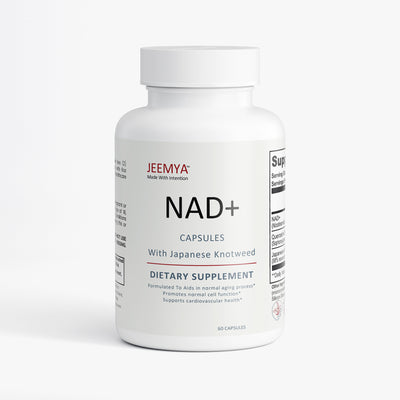
Jeemya NAD+: Triple-Action Longevity Stack
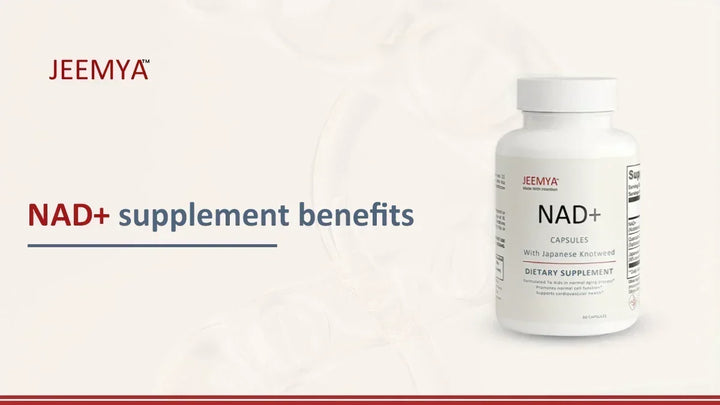
Jeemya NAD+ is formulated as a clinically aligned longevity stack combining three complementary compounds in a single capsule:
- NAD+ 500mg: Direct cellular energy coenzyme support*
- Quercetin Dihydrate 250mg: A senolytic flavonoid also found in red grapes and onions, studied for its role in supporting healthy cellular aging*
- Japanese Knotweed Resveratrol 98% 150mg: One of the most potent standardized trans-resveratrol sources available, from the same plant (Polygonum cuspidatum) used in the most-cited resveratrol research*
What makes this stack significant is the synergistic design: rather than taking resveratrol alone, Jeemya NAD+ delivers the sirtuin activator (resveratrol) alongside the cofactor those sirtuins need (NAD+) addressing both sides of the cellular energy equation simultaneously.
Jeemya Resveratrol 50% 600mg: Entry-Level Sirtuin Support
For those beginning their resveratrol journey, Jeemya Resveratrol 50% 600mg delivers:
- Trans-Resveratrol 50% Complex from Polygonum cuspidatum root at 600mg per serving
- 50% standardization not the generic, low-potency resveratrol found in most products
- 60 servings per bottle a full two-month supply at studied dosing
- Aligned with the research framework associated with Dr. David Sinclair's sirtuin longevity studies at Harvard
⚠️ These statements have not been evaluated by the Food and Drug Administration. These products are not intended to diagnose, treat, cure, or prevent any disease.
FAQs
Which red wine has the most resveratrol?
Resveratrol levels in red wine vary depending on the grape variety, growing conditions, and winemaking process. Although red wine contains resveratrol, the amount is generally relatively low, making it difficult to obtain concentrated amounts through wine consumption alone. If your goal is to support healthy aging, cellular energy, and overall wellness, a targeted approach such as Jeemya's NAD+ Supplement can provide a more consistent way to support your body's NAD+ pathways without the alcohol and additional calories associated with wine.
Does red wine speed up metabolism?
Current evidence does not support red wine as a metabolism booster. Although red wine contains resveratrol, the concentration is relatively low compared with amounts used in some research studies. Wine also contains alcohol and calories, which can offset potential metabolic benefits. Resveratrol supplementation is being studied for its potential effects on metabolic health, but more research is needed to establish its effectiveness as a metabolism-supporting intervention.
Is red wine good for weight loss?
Red wine should not be considered a weight loss tool. Some observational studies have reported associations between moderate alcohol consumption and certain health outcomes, but these findings do not establish that red wine causes weight loss. Alcohol provides calories and may influence appetite and eating behavior. For healthy weight management, a balanced diet, regular physical activity, adequate sleep, and sustainable calorie intake are more reliable approaches.
What is the relationship between resveratrol and NAD+?
Resveratrol and NAD+ are involved in cellular pathways related to energy metabolism and healthy aging. Resveratrol has been studied for its potential effects on sirtuins, a family of proteins involved in cellular regulation, while NAD+ is required as a cofactor for sirtuin activity. This has led researchers to investigate the relationship between resveratrol availability, NAD+ metabolism, mitochondrial function, and cellular aging. However, the clinical significance of combining resveratrol and NAD+ supplementation in humans remains an active area of research.
Can NAD+ supplements support cellular energy?
NAD+ plays a central role in cellular energy production and is involved in metabolic pathways that help mitochondria convert nutrients into ATP. NAD+ metabolism also changes with age, and researchers are investigating whether NAD+ precursors or direct NAD+ supplementation can support cellular energy and mitochondrial function in adults. Supplementing with NAD+ precursors or direct NAD+ remains an active area of research. Explore our guide on what fruits boost metabolism for complementary dietary strategies.
Scientific References
- NIH Office of Dietary Supplements: Dietary Supplements for Weight Loss: Fact Sheet for Health Professionals
- NCCIH: Antioxidants: In Depth (Resveratrol and Polyphenol Context)
- PubMed: Resveratrol supplementation significantly influences obesity measures: a systematic review and dose-response meta-analysis of randomized controlled trials
Mousavi SM, Milajerdi A, Sheikhi A, Kord-Varkaneh H, Feinle-Bisset C, Larijani B, Esmaillzadeh A. Resveratrol supplementation significantly influences obesity measures: a systematic review and dose-response meta-analysis of randomized controlled trials. Obes Rev. 2019 Mar;20(3):487-498. doi: 10.1111/obr.12775. Epub 2018 Dec 5. PMID: 30515938
Gepner Y, Golan R, Harman-Boehm I, Henkin Y, Schwarzfuchs D, Shelef I, Durst R, Kovsan J, Bolotin A, Leitersdorf E, Shpitzen S, Balag S, Shemesh E, Witkow S, Tangi-Rosental O, Chassidim Y, Liberty IF, Sarusi B, Ben-Avraham S, Helander A, Ceglarek U, Stumvoll M, Blüher M, Thiery J, Rudich A, Stampfer MJ, Shai I. Effects of Initiating Moderate Alcohol Intake on Cardiometabolic Risk in Adults With Type 2 Diabetes: A 2-Year Randomized, Controlled Trial. Ann Intern Med. 2015 Oct 20;163(8):569-79. doi: 10.7326/M14-1650. Epub 2015 Oct 13. PMID: 26458258.
Covarrubias AJ, Perrone R, Grozio A, Verdin E. NAD+ metabolism and its roles in cellular processes during ageing. Nat Rev Mol Cell Biol. 2021 Feb;22(2):119-141. doi: 10.1038/s41580-020-00313-x. Epub 2020 Dec 22. PMID: 33353981; PMCID: PMC7963035.
- PubMed: NAD+ and sirtuins in aging and disease: Imai S, Guarente L. NAD+ and sirtuins in aging and disease. Trends Cell Biol. 2014 Aug;24(8):464-71. doi: 10.1016/j.tcb.2014.04.002. Epub 2014 Apr 29. PMID: 24786309; PMCID: PMC4112140.
- PubMed: Influence of moderate daily wine consumption on body weight regulation and metabolism in healthy free-living males Cordain L, Bryan ED, Melby CL, Smith MJ. Influence of moderate daily wine consumption on body weight regulation and metabolism in healthy free-living males. J Am Coll Nutr. 1997 Apr;16(2):134-9. doi: 10.1080/07315724.1997.10718663. PMID: 9100213..

0 comments