
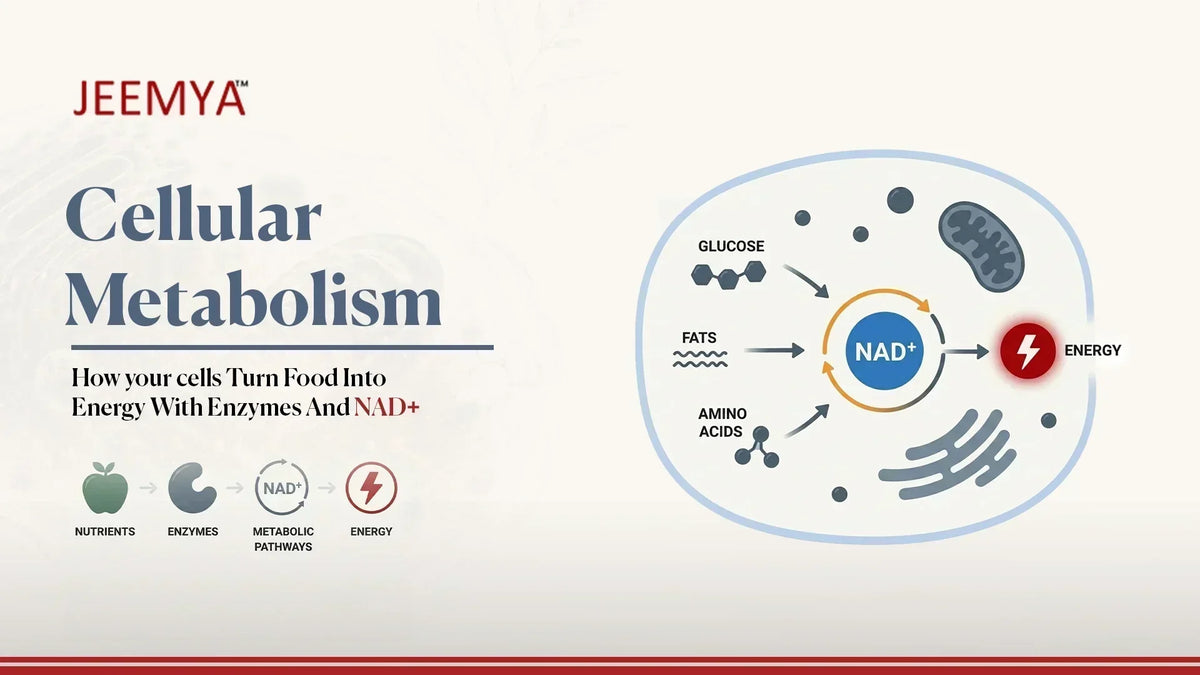
Your body is running trillions of chemical reactions right now to power every heartbeat, thought, and immune response. All of this depends on cellular metabolism—the complete set of biochemical reactions inside your cells that converts food into usable energy, repairs tissue, eliminates waste, and maintains your body's delicate internal balance.
When your cellular metabolism functions well, you experience sustained energy, clear thinking, and resilient immunity. Understanding how this process works at the cellular level is the foundation for making better choices about what you put in your body and what your cells truly need to thrive.
What Do Enzymes Do?
Every single chemical reaction inside your cells depends on enzymes — specialized proteins that act as biological catalysts. Without them, the reactions necessary for life would either happen too slowly to sustain you, or wouldn't happen at all.
Here's what makes enzymes remarkable: they don't just speed up reactions — they make reactions possible under the mild conditions inside your body. Your cells operate at roughly 37°C (98.6°F) and neutral pH. Without enzymatic catalysis, the same reactions would require extreme temperatures or pressures that would destroy living tissue.
How Enzymes Work
Each enzyme has a highly specific three-dimensional shape with an active site — a region where a particular molecule (called a substrate) fits like a key into a lock. When the substrate binds to the active site, the enzyme lowers the activation energy required for the reaction to proceed. The reaction happens, the products are released, and the enzyme is free to repeat the process — often thousands of times per second.
This specificity is critical. Lipid metabolism requires different enzymes than glucose metabolism. The enzymes that break down fatty acids in your mitochondria are entirely different from those that split glucose during glycolysis. This compartmentalization allows your cells to run multiple metabolic processes simultaneously without interference.
Why Enzyme Function Declines
Enzymes require specific conditions to maintain their shape and activity:
- Cofactors and coenzymes — Many enzymes cannot function without helper molecules. NAD+, for example, is a coenzyme required by over 500 enzymatic reactions in the human body. When NAD+ levels decline — which research shows happens progressively with age — hundreds of enzymatic processes slow down simultaneously.
- pH and temperature sensitivity — Even small shifts in cellular pH can alter enzyme shape, reducing catalytic efficiency.
- Oxidative damage — Free radicals can damage enzyme structures, impairing their function over time.
The takeaway: enzymes are the workforce of cellular metabolism. When they have what they need — proper cofactors, substrates, and a balanced cellular environment — your metabolism operates at full capacity. When they don't, everything slows.
What Are Metabolic Pathways?
A metabolic pathway is a series of connected chemical reactions, where the product of one reaction becomes the substrate for the next. Think of it as an assembly line — or a disassembly line — depending on the direction.
Your cells use metabolic pathways to accomplish two fundamental objectives:
Catabolism — Breaking Down for Energy
Catabolism refers to the breakdown of complex molecules into simpler ones, releasing energy in the process. This is how your body extracts usable fuel from food.
The three major catabolic pathways:
- Glycolysis — Occurs in the cytoplasm. Splits one glucose molecule into two pyruvate molecules, generating 2 ATP and 2 NADH molecules. This is the first step of glucose metabolism and happens in every cell of your body.
- The Citric Acid Cycle (TCA/Krebs Cycle) — Occurs inside mitochondria. Takes acetyl-CoA (derived from glucose, fatty acids, or amino acids) and oxidizes it through 8 sequential reactions, producing CO₂, NADH, FADH₂, and GTP. This is where the majority of electron carriers are generated for cellular energy production.
- Oxidative Phosphorylation (Electron Transport Chain) — The final stage. NADH and FADH₂ donate electrons to a chain of protein complexes in the inner mitochondrial membrane. As electrons pass through, protons are pumped across the membrane, creating a gradient that drives ATP synthase — producing the bulk of your cell's ATP.
A single glucose molecule, fully oxidized through these pathways, generates approximately 30–36 ATP molecules. This is why energy metabolism is often described as your body's most fundamental process — without ATP, nothing else happens.
Anabolism — Building Up for Growth and Repair
Anabolism is the opposite: using energy (ATP) to build complex molecules from simpler precursors. This includes:
- Protein synthesis — Assembling amino acids into functional proteins (muscle, enzymes, hormones)
- Lipid synthesis — Building cell membranes, storing energy as triglycerides
- Nucleotide synthesis — Creating DNA and RNA for cell division and repair
- Glycogen synthesis — Storing glucose in liver and muscle for later use
Catabolism and anabolism are not separate systems — they're two sides of the same metabolic coin, constantly running in parallel and regulated by enzymes, hormones, and cofactors like NAD+.
How Do Cells Keep Chemical Reactions in Balance?
Your cells face a constant challenge: running thousands of reactions simultaneously while maintaining internal stability. This state of dynamic equilibrium is called homeostasis — and it is one of the most sophisticated achievements of biological systems.
Feedback Inhibition
The primary way cells self-regulate is through feedback inhibition. When a metabolic pathway produces enough of its end product, that product binds to an enzyme earlier in the pathway and temporarily shuts it down. When levels drop, the inhibition is released, and production resumes.
For example, when ATP levels are high (meaning the cell has plenty of energy), key enzymes in glycolysis and the TCA cycle are inhibited — slowing glucose metabolism until energy is actually needed. When ATP drops and AMP rises, those same enzymes are activated, accelerating catabolism.
Hormonal Regulation
At the systemic level, hormones coordinate metabolic activity across billions of cells:
- Insulin signals cells to take up glucose and store energy (favoring anabolism)
- Glucagon signals cells to release stored glucose and burn fat (favoring catabolism)
- Thyroid hormones set the overall metabolic rate — how fast or slow your basal energy metabolism runs
- Cortisol mobilizes energy during stress, affecting both glucose metabolism and lipid metabolism
Redox Balance: The NAD+/NADH Ratio
One of the most critical homeostatic mechanisms operates at the molecular level through the NAD+/NADH ratio. This ratio acts as a real-time sensor of your cell's energy state:
- High NAD+/NADH = the cell has capacity to accept more electrons, signaling that catabolic pathways should be active
- Low NAD+/NADH = the cell is saturated with electrons, signaling that energy production should slow down
This ratio doesn't just reflect energy status — it actively controls it. NAD+ activates sirtuins (longevity-associated enzymes), stimulates mitochondrial function, and maintains the flow of electrons through the entire energy metabolism chain. When this ratio is disrupted — through aging, poor nutrition, or chronic stress — homeostasis deteriorates and metabolic dysfunction follows.
How Do Cells Manage All Their Chemical Reactions?
The sheer scale of cellular metabolism is staggering. A single cell runs approximately 37 billion chemical reactions per second. Managing this without chaos requires extraordinary organizational systems.
Compartmentalization
Cells separate incompatible reactions into distinct compartments:
- Cytoplasm — glycolysis, fatty acid synthesis, pentose phosphate pathway
- Mitochondria — TCA cycle, oxidative phosphorylation (the primary site of cellular energy production), beta-oxidation of fatty acids (lipid metabolism)
- Endoplasmic reticulum — protein folding, lipid synthesis
- Nucleus — DNA replication, RNA transcription, epigenetic regulation
Each compartment maintains its own NAD+ pool, its own enzyme sets, and its own regulatory logic. This prevents cross-interference and allows catabolism and anabolism to run simultaneously in different locations within the same cell.
Metabolic Flexibility
Healthy cells can switch between fuel sources depending on availability. When glucose is abundant, glucose metabolism dominates. During fasting or low-carbohydrate states, cells shift toward lipid metabolism — breaking down fatty acids through beta-oxidation to fuel the TCA cycle.
This metabolic flexibility is a hallmark of cellular health. Metabolically inflexible cells — those locked into one fuel source — are associated with insulin resistance, obesity, and type 2 diabetes.
Signal Integration
Cells integrate signals from dozens of sources simultaneously:
- Nutrient availability (glucose, amino acids, fatty acids)
- Energy status (ATP/AMP ratio, NAD+/NADH ratio)
- Growth signals (hormones, growth factors)
- Stress signals (oxidative stress, DNA damage, inflammation)
All of these inputs converge on central regulatory hubs — like AMPK, mTOR, and the sirtuin family — which then adjust metabolic pathway activity in real time. Energy for metabolism is allocated dynamically, not statically. Your cells are constantly recalculating priorities.
What Is NAD+ and Why Is It Important for Metabolism?
If cellular metabolism is the engine, then NAD+ (nicotinamide adenine dinucleotide) is the ignition system. Without it, the engine doesn't run.
NAD+ is a coenzyme found in every living cell. It participates in over 500 enzymatic reactions — more than any other vitamin-derived molecule in human biology. Its roles fall into two major categories:
-
Electron Carrier in Energy Metabolism
NAD+ accepts electrons (in the form of hydride ions) during catabolic reactions, becoming NADH. This happens at critical steps in glycolysis, the TCA cycle, and fatty acid oxidation. The NADH then delivers those electrons to the electron transport chain, where they're used to generate ATP through oxidative phosphorylation.
Without NAD+:
- Glycolysis stalls (glucose metabolism stops)
- The TCA cycle cannot turn (cellular energy production collapses)
- Fatty acid oxidation halts (lipid metabolism fails)
- ATP production plummets
Every single energy-yielding pathway in your body requires NAD+. It is not optional — it is essential to energy and metabolism at the most fundamental level.
-
Substrate for Signaling Enzymes
Beyond energy metabolism, NAD+ is consumed as a substrate by three critical enzyme families:
- Sirtuins (SIRT1–7) — NAD+-dependent deacetylases that regulate gene expression, mitochondrial biogenesis, inflammation, DNA repair, and metabolic adaptation. When NAD+ levels are high, sirtuins are active, promoting cellular resilience and longevity. When NAD+ drops, sirtuin activity declines — and aging-related dysfunction accelerates.
- PARPs (Poly ADP-Ribose Polymerases) — Use NAD+ to repair damaged DNA. Under chronic stress or aging, PARP activity can consume massive amounts of NAD+, depleting the pool available for energy metabolism.
- CD38 — An enzyme whose activity increases with age, progressively degrading NAD+ faster than your body can replenish it.
The Age-Related NAD+ Decline
Research consistently shows that NAD+ levels decline by 40–60% between ages 40 and 60 in key tissues including muscle, brain, liver, and skin. This decline is now considered a hallmark of metabolic aging — not just a byproduct of it.
The consequences cascade through every system:
- Reduced ATP production → chronic fatigue, reduced physical performance
- Impaired sirtuin activity → accelerated aging, increased inflammation
- Compromised DNA repair → accumulated cellular damage
- Disrupted homeostasis → metabolic dysfunction, weight gain, cognitive decline
This is why emerging research focuses intensely on strategies to maintain or restore NAD+ levels — because it sits upstream of virtually every metabolic pathway that determines how well your cells function.
Choosing a Quality Metabolism Supplement? Jeemya Can Help You Out.
Understanding cellular metabolism leads to a clear conclusion: supporting your cells' fundamental biochemistry — particularly NAD+ availability — is one of the highest-leverage actions you can take for long-term metabolic health.
But not all NAD+ supplements are created equal. The supplement industry is flooded with underdosed, poorly formulated products that may not actually raise intracellular NAD+ levels where it matters.
What to look for in a quality metabolism supplement:
- Clinically relevant dosing — Research on NAD+ precursors shows meaningful effects at specific threshold doses, not token amounts
- Bioavailability — The compound must actually reach your cells, survive digestion, and enter the NAD+ biosynthesis pathway
- Purity verification — Third-party tested, with a Certificate of Analysis confirming what's on the label is what's in the bottle
- No unnecessary fillers — Clean formulations without artificial colors, flavors, or questionable additives
Jeemya NAD+ was designed with exactly these principles. Formulated to support cellular energy production through the NAD+ biosynthesis pathway, it targets the foundational molecule that your enzymes, mitochondria, and metabolic signaling systems all depend on.
Because when your NAD+ levels are supported, you're not just boosting one pathway — you're supporting the upstream molecule that powers hundreds of reactions simultaneously. That's the difference between a symptom-level supplement and one that addresses root-cause metabolic function.
Frequently Asked Questions
What are the 4 stages of cell metabolism?
The four primary stages of cellular metabolism that convert food into ATP are:
- Glycolysis — Glucose is split into two pyruvate molecules in the cytoplasm, producing 2 ATP and 2 NADH
- Pyruvate Oxidation — Pyruvate enters mitochondria and is converted to acetyl-CoA, releasing CO₂ and generating NADH
- The Citric Acid Cycle (Krebs Cycle) — Acetyl-CoA is fully oxidized, producing CO₂, NADH, FADH₂, and GTP
- Oxidative Phosphorylation — Electrons from NADH and FADH₂ pass through the electron transport chain, driving ATP synthase to produce approximately 30–34 ATP per glucose molecule
These stages work sequentially — the output of each becomes the input for the next. Together, they represent the core of cellular energy production.
What happens when cellular metabolism is impaired?
When cellular metabolism is impaired, cells cannot efficiently convert nutrients into energy or maintain their repair processes. The effects include:
- Chronic fatigue — Insufficient ATP means cells lack the energy for normal function
- Mitochondrial dysfunction — Damaged mitochondria produce less ATP and more reactive oxygen species (oxidative stress)
- Accumulation of metabolic waste — Impaired catabolism means byproducts build up, triggering inflammation
- Disrupted homeostasis — The NAD+/NADH ratio becomes imbalanced, impairing hundreds of enzymatic reactions
- Accelerated aging — DNA repair slows, sirtuin activity declines, and cellular senescence increases
Metabolic impairment is now understood as a root driver — not just a symptom — of conditions including insulin resistance, neurodegenerative disease, cardiovascular decline, and age-related frailty.
What are signs of a slow metabolism?
Signs that your energy metabolism may be underperforming at the cellular level include:
- Persistent fatigue despite adequate sleep
- Unexplained weight gain or difficulty losing weight
- Feeling cold frequently (reduced thermogenesis)
- Brain fog, poor concentration, or memory decline
- Slow recovery from exercise or illness
- Dry skin, thinning hair, or brittle nails
- Digestive sluggishness
- Muscle weakness or loss of lean mass
These symptoms often reflect impaired mitochondrial function, declining NAD+ levels, or disrupted hormonal signaling — all of which affect how efficiently your cells produce and use energy for metabolism.
How to improve cellular metabolism?
Evidence-based strategies to support and improve cellular metabolism include:
- Support NAD+ levels — NAD+ is required for over 500 metabolic reactions. Supplementation with NAD+ precursors or direct NAD+ is one of the most researched approaches to restoring metabolic efficiency at the cellular level.
- Exercise regularly — Both aerobic and resistance training stimulate mitochondrial biogenesis, improve metabolic flexibility, and naturally boost NAD+ through increased NAMPT enzyme activity.
- Prioritize nutrient-dense foods — Adequate B-vitamins (particularly B3/niacin), amino acids, and antioxidants provide the raw materials enzymes need to function.
- Practice intermittent fasting or caloric restriction — Temporarily reducing caloric intake activates AMPK and sirtuins, stimulating autophagy (cellular cleanup) and metabolic adaptation.
- Manage chronic stress — Prolonged cortisol elevation disrupts glucose metabolism, impairs mitochondrial function, and accelerates NAD+ depletion through increased PARP activity.
- Optimize sleep — Circadian rhythm directly regulates NAD+ biosynthesis through the NAMPT/SIRT1 feedback loop. Disrupted sleep disrupts NAD+ cycling.
- Reduce excessive alcohol and processed foods — Both drain NAD+ reserves and increase oxidative damage to mitochondria.
Related Reading
Looking to dive deeper into specific strategies for supporting your metabolic health? Explore these resources:
- What Are Metabolism Boosting Foods? — Discover which whole foods naturally support your body's metabolic pathways and enzymatic function.
- What Supplements Boost Metabolism? — A science-backed look at supplements that genuinely influence energy metabolism at the cellular level.
- How to Boost Your Metabolism Without Exercise — Non-exercise strategies including cold exposure, sleep optimization, and targeted nutrition that support metabolic rate.
- Does Water Boost Metabolism? — What the research actually says about hydration's impact on metabolic rate and cellular function.
- What Are the 5 Superfoods That Boost Metabolism? — Five nutrient-dense foods with evidence-backed effects on metabolic health and energy production.
This article is for educational purposes only and is not intended to diagnose, treat, cure, or prevent any disease. Consult your healthcare provider before starting any supplement regimen.

0 comments