
Does eating breakfast boost metabolism? Not in the way most people think. Eating breakfast does not raise your resting metabolism, and skipping it does not slow your metabolism down. In a 6-week randomized trial, adults who ate a daily breakfast had a resting metabolic rate within 11 calories a day of those who fasted until noon. What breakfast does change is how much you move, how hungry you feel later, and how steady your blood sugar stays. And when you eat matters: your body spends more energy digesting a morning meal than the same meal at night.
At Jeemya, we think that difference is worth understanding, because it changes how you plan your mornings. In this guide we walk through how metabolism works, where the "breakfast kickstart" idea came from, what the strongest trials found, who should not skip breakfast, and how to build a breakfast that supports your energy and appetite.
Does Eating Breakfast Boost Metabolism? The Short Answer
Here is what the best human research shows about breakfast and metabolism:
- Resting metabolism does not change. In the Bath Breakfast Project, resting metabolic rate stayed within 11 kcal a day whether people ate breakfast or fasted until noon for 6 weeks.
- Breakfast eaters moved more. The same trial found that people who ate breakfast burned about 442 more calories a day through physical activity.
- They also ate more. Breakfast eaters took in about 539 more calories a day, so weight and body fat did not change between groups.
- Timing changes digestion cost. A 2020 study found that the calories burned digesting a meal were 2.5 times higher after breakfast than after the same meal at dinner.
- Weight loss is not guaranteed. A 2019 BMJ meta-analysis of 13 trials found that adding breakfast did not help people lose weight.
So, does breakfast kickstart your metabolism? It gives your day a slightly more efficient start, but it does not flip a switch that burns extra calories all day. If you want morning habits that make a real difference, our guide on how to boost metabolism in the morning covers light exposure, movement, hydration, and protein.
How Your Metabolism Works: Resting Burn, Digestion, and Movement
"Metabolism" usually refers to how many calories your body burns in a day. That total has three parts:
- Basal or resting metabolic rate (RMR): the energy you burn at rest to keep your heart beating, lungs breathing, and cells working. This is the largest part for most people.
- Diet-induced thermogenesis (DIT), also called the thermic effect of food (TEF): the energy used to digest, absorb, and store food. With a mixed diet, it is about 10% of daily energy expenditure.
- Physical activity: everything from planned workouts to walking, standing, and fidgeting. This is the part that varies most from person to person.
The thermic effect of food depends mostly on how much you eat and what you eat. According to a review by Klaas Westerterp in Nutrition and Metabolism (2004), the share of a nutrient's calories used to process it is roughly:
|
Nutrient |
Calories used to process it |
|
Protein |
20% to 30% |
|
Carbohydrate |
5% to 10% |
|
Fat |
0% to 3% |
|
Alcohol |
10% to 30% |
This explains a common mistake. Eating breakfast does create a thermic effect, but so does every other meal. If you eat the same total food in two meals or three, your daily thermic effect is about the same. Splitting food into more meals does not add burn either, which is what our article on does eating 6 times a day boost metabolism explains in detail. Timing can tweak this number, as we will see below, but the main drivers remain total intake, protein, muscle, and movement.
Where the "Breakfast Kickstarts Your Metabolism" Idea Came From
For decades, people have heard that breakfast is the most important meal of the day and that it "jump-starts" metabolism. Many hospital and health websites still say so. The idea rests on three things:
- Observational studies. Large surveys found that people who eat breakfast tend to weigh less and have fewer chronic diseases. But people who eat breakfast regularly often have other healthy habits too. This "healthy-user" effect makes it hard to know whether breakfast itself is responsible.
- The "starvation mode" belief. Many people believe that going hours without food makes the body hold on to calories. A normal overnight fast plus a skipped breakfast is far too short to trigger any meaningful drop in resting metabolism, as the Bath trial showed. The same myth drives advice to graze all day, which we cover in does eating every 3 hours boost your metabolism.
- A real but small effect. Digesting breakfast does burn calories, and that burn is higher in the morning. The mistake is assuming it carries on all day or adds up to much.
So, is breakfast the most important meal? For some people, such as children, athletes training early, or people with diabetes, it can be. For healthy adults, research suggests that the quality and size of your meals, and when you eat most of your food, matter more than whether the first meal happens at 7 a.m.
Does Skipping Breakfast Slow Your Metabolism?
The best answer comes from the Bath Breakfast Project, a randomized controlled trial led by James Betts at the University of Bath and published in the American Journal of Clinical Nutrition in 2014. Thirty-three lean adults aged 21 to 60 were assigned to one of two habits for 6 weeks:
- Eat at least 700 calories before 11 a.m. every day, or
- Eat nothing until noon each day.
The researchers measured every part of energy balance. The results:
- Resting metabolic rate: no meaningful change, within 11 kcal a day.
- Calories eaten: 539 kcal a day more with breakfast. Skippers did not make up the missed morning calories later in the day.
- Physical activity: 442 kcal a day more with breakfast.
- Weight and body fat: no difference between groups.
- Blood sugar: by the final week, blood sugar was more variable in the afternoon and evening for the fasting group.
So does skipping breakfast slow your metabolism? No. Your resting burn stays the same. But skipping may make you move a little less in the morning, and it can make blood sugar swing more later in the day.
Skipping can also change hunger. In a 2020 study at the University of Lübeck, eating a small breakfast and a large dinner increased hunger, especially appetite for sweets, through the rest of the day compared with eating a large breakfast. Some people respond by snacking all afternoon. If that sounds familiar, our article on does eating every 2 hours boost metabolism explains why frequent snacking does not raise your calorie burn either.
Breakfast Timing and Your Body Clock
Your body runs on a roughly 24-hour internal clock, called the circadian rhythm. It shapes when you feel alert, when hormones rise and fall, and how well you handle food. Chrononutrition, the study of meal timing and the body clock, has produced some of the most interesting findings on breakfast and metabolism.
Morning meals cost more energy to digest
In the University of Lübeck study, published in the Journal of Clinical Endocrinology and Metabolism in 2020, 16 normal-weight men completed two 3-day lab stays. In one, they ate a large breakfast (69% of their daily calorie needs) and a small dinner (11%). In the other, the meals were reversed. Diet-induced thermogenesis rose 2.5 times more after the morning meal than after the evening meal, whether the meal was large or small. Blood glucose and insulin also rose less after breakfast than after dinner.
Late eating lowers daytime burn and raises hunger
A 2022 trial at Brigham and Women's Hospital, published in Cell Metabolism, tested what happens when the same meals are pushed later. Sixteen adults with overweight or obesity followed an early schedule and a late schedule, with meals delayed by about 4 hours (250 minutes). On the late schedule, they burned about 5% fewer calories while awake, about 59 kcal less per day, had higher hunger, lower waking leptin (a fullness hormone), and lower core body temperature.
But total daily burn may not change
The Big Breakfast Study at the University of Aberdeen, also published in Cell Metabolism in 2022, tested 30 adults with overweight or obesity on two 4-week weight-loss diets with the same calories. One loaded 45% of calories at breakfast; the other loaded 45% at dinner. There was no difference in total daily energy expenditure, resting metabolic rate, or weight loss. The big-breakfast diet did reduce hunger.
Taken together, these studies point to a clear pattern. Eating earlier in the day uses food a bit more efficiently, keeps blood sugar steadier, and controls hunger better. Those are real benefits. But over a full day, the extra calories burned are small, and in a carefully controlled diet they did not lead to more weight loss.
What the Research Says: Breakfast and Metabolism Studies
The table below summarizes the key human research on whether eating breakfast boosts metabolism.
|
Study |
Design |
Main finding |
|
Betts et al., American Journal of Clinical Nutrition (2014), Bath Breakfast Project |
Randomized trial, 33 lean adults, 6 weeks; 700+ kcal breakfast vs. fasting until noon |
No change in resting metabolic rate (within 11 kcal/day). Breakfast eaters ate 539 kcal/day more and burned 442 kcal/day more through activity. No change in weight. Steadier afternoon blood sugar with breakfast. |
|
Dhurandhar et al., American Journal of Clinical Nutrition (2014) |
Randomized trial, 309 adults trying to lose weight, 16 weeks |
Advice to eat or skip breakfast had no effect on weight loss. Average changes were under 1 kg in all groups. |
|
Sievert et al., BMJ (2019) |
Meta-analysis of 13 randomized trials |
Breakfast eaters ate about 260 kcal/day more and weighed 0.44 kg more than skippers. Authors cautioned against recommending breakfast for weight loss. |
|
Richter et al., Journal of Clinical Endocrinology and Metabolism (2020) |
Randomized crossover, 16 normal-weight men, two 3-day lab stays |
Digestion burn was 2.5 times higher after breakfast than after dinner. Lower glucose and insulin rise after breakfast. Small breakfast increased hunger and sweet cravings. |
|
Jakubowicz et al., Obesity (2013) |
Randomized trial, women with overweight/obesity and metabolic syndrome, about 1,400 kcal/day, 12 weeks |
Big-breakfast group (700 kcal breakfast, 200 kcal dinner) lost more weight and waist size than the big-dinner group. Triglycerides fell 33.6% vs. rose 14.6%. |
|
Ruddick-Collins et al., Cell Metabolism (2022) |
Randomized crossover, 30 adults with overweight/obesity, two 4-week diets |
Morning-loaded vs. evening-loaded calories: no difference in total energy expenditure, resting metabolic rate, or weight loss. Less hunger with a big breakfast. |
|
Vujović et al., Cell Metabolism (2022) |
Randomized crossover, 16 adults with overweight/obesity |
Eating about 4 hours later lowered waking energy expenditure by about 5% (59 kcal/day), raised hunger, and lowered core body temperature. |
|
Li et al., Medicine (2021) |
Meta-analysis of 14 cohort studies |
Eating breakfast more than 3 times a week was linked to lower risk of type 2 diabetes (RR 0.80), obesity (RR 0.74), and cardiovascular death (RR 0.63). Observational, so it cannot show cause. |
The pattern is consistent. Breakfast does not raise resting metabolism, but meal timing affects digestion cost, hunger, and blood sugar. The number of meals you eat matters even less; see does eating 5 times a day boost metabolism for what the meal-frequency trials show.
Breakfast, Weight, and Long-Term Health
If breakfast does not boost metabolism, why do so many studies link it with better health? There are two honest answers.
First, the long-term data are observational. The 2021 meta-analysis by Li and colleagues pooled 14 cohort studies and found that regular breakfast eaters had lower rates of type 2 diabetes, obesity, metabolic syndrome, high blood pressure, stroke, and cardiovascular death. These links are strong and consistent, but people who eat breakfast regularly also tend to have other healthy habits.
Second, the trials show real benefits that are not about calorie burn. Breakfast can steady blood sugar later in the day, as in the Bath trial, and a larger breakfast can reduce hunger, as in the Lübeck and Aberdeen studies. In women with metabolic syndrome, shifting calories toward breakfast improved fasting glucose, insulin, insulin resistance (HOMA-IR), and triglycerides, according to Jakubowicz and colleagues.
For weight, the bottom line is simple: breakfast is neither a fat-burning tool nor a weight-gain trap. The 2019 BMJ meta-analysis found that adding breakfast tended to add calories. If eating breakfast helps you eat less later and choose better foods, it can support your goals. If you are not hungry in the morning and you eat well later, skipping it is a reasonable choice for most healthy adults.
How to Build a Breakfast That Supports Your Metabolism
If you eat breakfast, make it count. These steps use what the research shows about protein, fiber, timing, and hunger:
- Lead with protein. A high protein breakfast for metabolism makes the most of the thermic effect, since protein uses 20% to 30% of its calories during digestion. It also keeps you full longer. Aim for about 20 to 30 grams from foods like eggs, Greek yogurt, cottage cheese, tofu, or a protein smoothie.
- Add fiber. Oats, berries, chia seeds, whole-grain toast, and vegetables slow digestion and help steady blood sugar. If oats are your go-to, our guide do oats boost metabolism looks at what they can and cannot do.
- Eat earlier rather than later when you can. The timing studies suggest your body handles food better in the morning. Shifting more of your calories earlier and eating less late at night is more useful than fussing over the exact minute you eat breakfast.
- Match the size to your hunger. A breakfast that leaves you satisfied until lunch is the goal. If a big breakfast makes you eat less later, great. If it just adds calories, keep it smaller.
- Skip the sugar rush. Pastries, sweetened cereals, and juice raise blood sugar quickly and may leave you hungry again soon.
- Move after you eat. The extra activity seen in the Bath trial is the biggest calorie difference breakfast made. A 10-minute walk after breakfast is an easy way to capture it.
- Add coffee or tea if you enjoy them. Caffeine can give a small, short rise in energy use. Keep the sugar and creamers modest.
Some simple options: two eggs with spinach and whole-grain toast; Greek yogurt with berries and a spoon of chia seeds; overnight oats made with milk and a scoop of protein powder; or a tofu scramble with vegetables.
Who Should Not Skip Breakfast? Safety and When to Talk to a Doctor
For most healthy adults, skipping breakfast is safe. Some people should be more careful and talk to their doctor before changing their meal pattern:
- People with diabetes, especially those taking insulin or other medicines that lower blood sugar. Skipping a meal can lead to low blood sugar (hypoglycemia). Medicine timing may need to change.
- Pregnant or breastfeeding women, who have higher energy and nutrient needs.
- Children and teens, who are still growing and may focus and learn better with breakfast.
- Older adults with a small appetite, who risk not getting enough protein to protect muscle.
- Athletes and people who train in the morning, who may perform and recover better with food before or after training.
- Anyone with a history of disordered eating. Rigid meal skipping can be a trigger. Support is available from the National Alliance for Eating Disorders helpline.
- People taking medicines that must be taken with food. Check the label or ask your pharmacist.
If you feel dizzy, shaky, or unusually tired when you skip breakfast, or if you have a medical condition, talk to your healthcare provider before making changes.
Breakfast, Your Body Clock, and Cellular Energy
The timing studies show that your metabolism runs on a daily rhythm. That rhythm reaches all the way into your cells. NAD+ (nicotinamide adenine dinucleotide) is a coenzyme found in every living cell. Your mitochondria use it to turn food into usable energy, and many enzymes involved in DNA repair and cell signaling depend on it.
Research in mice, published by Ramsey and colleagues in Science in 2009, found that NAD+ levels and NAMPT, the enzyme that limits how fast NAD+ is made, rise and fall on a daily cycle controlled by the body clock. NAD+ then feeds back to help keep the clock on time. Reviews of human and animal research also note that NAD+ levels tend to fall with age. This is one reason regular meal timing, good sleep, and support for cellular energy work together: they all help your metabolism keep its natural rhythm.
How Jeemya NAD+ 500 mg Can Support Your Cellular Energy
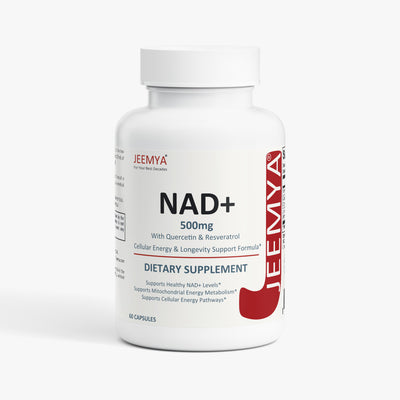
At Jeemya, we created our NAD+ 500 mg for people who want to support their energy at the source. Each serving provides 500 mg of NAD+, the coenzyme your mitochondria use every time they turn breakfast, lunch, or dinner into energy. It fits easily into a morning routine alongside a protein-rich breakfast. It is made with clean ingredients, produced with GMP-minded standards, and labeled transparently, so you always know what you are taking. It is designed to support cellular energy production and healthy aging, not to replace balanced meals, movement, or sleep. Research on oral NAD+ in people is still growing, so talk to your healthcare provider before adding it, especially if you take other medicines.
Looking for Science-Backed Metabolism Support? Explore Jeemya.
A balanced breakfast, eaten at a sensible time, is a simple way to support steady energy and appetite. If you want more support for your energy and metabolic health, Jeemya offers daily formulas made with clean ingredients and transparent labels. Our NAD+ 500 mg supports cellular energy, and our Berberine HCl 800 mg supports healthy glucose metabolism. Every order comes with a 30-day money-back guarantee. Talk to your healthcare provider before starting any new supplement.
Frequently Asked Questions
Does eating breakfast boost metabolism for the whole day?
No. Breakfast does not raise your resting metabolic rate. Digesting it burns some calories, and that burn is higher in the morning than at night, but the effect lasts only a few hours after the meal.
Does skipping breakfast put you in "starvation mode"?
No. A normal overnight fast followed by a late first meal is far too short to slow your metabolism. In a 6-week trial, resting metabolic rate stayed within 11 calories a day whether people ate breakfast or fasted until noon.
Will eating breakfast help me lose weight?
Not by itself. A 2019 BMJ meta-analysis of 13 trials found that breakfast eaters ate about 260 more calories a day and did not lose more weight. Breakfast can help if it reduces your hunger and snacking later.
What is the best breakfast for metabolism?
A breakfast built around protein and fiber, such as eggs with vegetables or Greek yogurt with berries and oats. Protein uses the most energy to digest and keeps you full longer.
Is it better to eat a big breakfast or a big dinner?
Research favors eating more earlier in the day. Big breakfasts reduce hunger and lead to lower blood sugar and insulin responses than the same meal at night. But in one carefully controlled trial, total calories burned and weight loss were the same either way.
Does coffee count as breakfast?
Black coffee has almost no calories, so it does not count as a meal. It can briefly raise energy use and alertness, but it does not replace the protein and fiber a balanced breakfast provides.
How soon after waking should I eat breakfast?
There is no proven ideal window. Eat when you are hungry, and try to place more of your daily food earlier in the day and less late at night. People with diabetes should follow their care team's advice on meal timing.
References
- Betts JA, Richardson JD, Chowdhury EA, Holman GD, Tsintzas K, Thompson D. The causal role of breakfast in energy balance and health: a randomized controlled trial in lean adults. American Journal of Clinical Nutrition. 2014;100(2). https://pmc.ncbi.nlm.nih.gov/articles/PMC4095658/
- Dhurandhar EJ, Dawson J, Alcorn A, et al. The effectiveness of breakfast recommendations on weight loss: a randomized controlled trial. American Journal of Clinical Nutrition. 2014;100(2):507. https://pmc.ncbi.nlm.nih.gov/articles/PMC4095657/
- Sievert K, Hussain SM, Page MJ, et al. Effect of breakfast on weight and energy intake: systematic review and meta-analysis of randomised controlled trials. BMJ. 2019;364:l42. https://pmc.ncbi.nlm.nih.gov/articles/PMC6352874/
- Richter J, Herzog N, Janka S, Baumann T, Kistenmacher A, Oltmanns KM. Twice as high diet-induced thermogenesis after breakfast vs dinner on high-calorie as well as low-calorie meals. Journal of Clinical Endocrinology and Metabolism. 2020;105(3):e211-e221. https://academic.oup.com/jcem/article/105/3/e211/5740411
- Jakubowicz D, Barnea M, Wainstein J, Froy O. High caloric intake at breakfast vs. dinner differentially influences weight loss of overweight and obese women. Obesity. 2013;21(12):2504-2512. https://pubmed.ncbi.nlm.nih.gov/23512957/
- Ruddick-Collins LC, Morgan PJ, Fyfe CL, et al. Timing of daily calorie loading affects appetite and hunger responses without changes in energy metabolism in healthy subjects with obesity. Cell Metabolism. 2022. https://pmc.ncbi.nlm.nih.gov/articles/PMC9605877/
- Vujović N, Piron MJ, Qian J, et al. Late isocaloric eating increases hunger, decreases energy expenditure, and modifies metabolic pathways in adults with overweight and obesity. Cell Metabolism. 2022;34(10):1486. https://pmc.ncbi.nlm.nih.gov/articles/PMC10184753/
- Li ZH, Xu L, Dai R, Li LJ, Wang HJ. Effects of regular breakfast habits on metabolic and cardiovascular diseases: a protocol for systematic review and meta-analysis. Medicine. 2021. https://pmc.ncbi.nlm.nih.gov/articles/PMC8568444/
- Westerterp KR. Diet induced thermogenesis. Nutrition and Metabolism. 2004;1:5. https://pmc.ncbi.nlm.nih.gov/articles/PMC524030/
- Ramsey KM, Yoshino J, Brace CS, et al. Circadian clock feedback cycle through NAMPT-mediated NAD+ biosynthesis. Science. 2009. https://pmc.ncbi.nlm.nih.gov/articles/PMC2738420/
- Amjad S, Nisar S, Bhat AA, et al. Role of NAD+ in regulating cellular and metabolic signaling pathways. Molecular Metabolism. 2021;101195. https://pmc.ncbi.nlm.nih.gov/articles/PMC7973386/
- Harvard Health Publishing. Eating breakfast won't help you lose weight, but skipping it might not either. 2019. https://www.health.harvard.edu/blog/eating-breakfast-wont-help-you-lose-weight-but-skipping-might-not-either-2019041916457
Medical disclaimer: This article is for general information only and is not medical advice. It does not replace a consultation with a qualified healthcare provider. Talk to your doctor before making major changes to your diet or meal timing, especially if you have diabetes or another health condition, are pregnant or breastfeeding, or take medication.

0 comments