
Does B12 boost metabolism? Only if your levels are low. Vitamin B12 is a working part of the machinery that turns food into energy, so running short of it can leave you tired, foggy, and less active. Correcting a deficiency brings that machinery back to normal. But if your B12 levels are already healthy, extra B12 from pills, shots, or IV drips does not make your body burn more calories.
That answer disappoints a lot of people, because B12 is sold everywhere as an energy and weight-loss shortcut. At Jeemya we would rather give you the full picture: what B12 does inside your cells, why low B12 and higher body weight often show up together, who is most likely to run low, how much you need, and what moves your metabolism in a meaningful way.
Does B12 Boost Metabolism? The Short Answer
Here is what the evidence supports:
- B12 is required for metabolism, not a booster of it. It acts as a helper (cofactor) for two enzymes. One of them sits on a pathway that feeds the energy-producing Krebs cycle in your mitochondria.
- Deficiency slows you down. Low B12 can cause anemia and fatigue, which lowers how much you move during the day.
- Extra B12 does not add extra burn. The NIH Office of Dietary Supplements states that B12 supplements do not appear to improve energy or endurance in people who already have enough. Mayo Clinic says there is no solid proof that B12 shots help with weight loss.
- The weight link is real but unclear. In a study of 9,075 US adults, people with the highest blood B12 levels had 29% lower odds of obesity than those with the lowest. But a 2-year randomized trial of B12 plus folic acid found no change in BMI or body fat.
So, does B12 boost your metabolism? It restores a metabolism that has been held back by a deficiency. It does not push a healthy one past normal. If you are comparing options, our guide on what supplements boost metabolism explains which ingredients have human data behind them and which rely mostly on marketing.
What Vitamin B12 Does in Your Body
Vitamin B12, also called cobalamin, is a water-soluble vitamin that contains the mineral cobalt. Your body needs it for three big jobs:
- Making healthy red blood cells, which carry oxygen to every tissue.
- Making DNA, so cells can divide and repair.
- Building and protecting nerves, including the myelin sheath that insulates them.
B12 comes in several forms. Cyanocobalamin is the most common form in supplements. Methylcobalamin and adenosylcobalamin are the two active forms your cells use, and hydroxocobalamin is a form often used in prescription injections.
Getting B12 from food into your cells takes several steps. Stomach acid and enzymes release B12 from the protein in food. It then binds to a protein called haptocorrin, and later to intrinsic factor, a protein made by cells in the stomach lining. The B12 and intrinsic factor complex is absorbed at the end of the small intestine (the distal ileum). If any step fails, you can become low in B12 even when your diet contains plenty. This is why age, stomach conditions, surgery, and some medicines matter so much.
Your body also stores B12 well. It holds about 1 to 5 mg, which is 1,000 to 2,000 times what you take in on a typical day. That is why symptoms of a deficiency can take several years to appear.
Vitamin B12 and Metabolism: Where the Vitamin Fits In
To understand vitamin B12 and metabolism, it helps to look at the two enzymes B12 supports. Both sit at the center of cellular metabolism, the chemistry each cell uses to turn nutrients into energy and building blocks.
1. L-methylmalonyl-CoA mutase: feeding the Krebs cycle
Inside your mitochondria, this enzyme uses adenosylcobalamin to convert methylmalonyl-CoA into succinyl-CoA. Succinyl-CoA is a step in the Krebs cycle (also called the citric acid cycle), the central loop that pulls energy out of food. This pathway handles the breakdown of odd-chain fatty acids and certain amino acids.
When B12 runs low, methylmalonyl-CoA builds up and spills into the blood as methylmalonic acid (MMA). A 2020 review in Nutrients by Boachie and colleagues describes how this build-up may block CPT1, the enzyme that moves fatty acids into mitochondria to be burned. In lab and animal studies, that block is linked to more fat stored in fat cells. This is the main reason researchers think low B12 might affect fat metabolism.
2. Methionine synthase: recycling homocysteine
In the fluid part of the cell, methylcobalamin helps methionine synthase turn homocysteine back into methionine. Methionine is then used to make S-adenosylmethionine (SAM), a molecule that supplies the "methyl groups" cells need to regulate genes and build many compounds. This enzyme also works hand in hand with folate. Without enough B12, homocysteine rises and red blood cell production goes wrong, which leads to megaloblastic anemia: large, immature red blood cells that carry oxygen poorly.
Put together, B12 keeps one fuel route into the Krebs cycle open and keeps your blood able to deliver oxygen. Neither job speeds up when you add more B12 than your enzymes need. A car needs oil to run, but filling the tank with extra oil does not make it go faster.
B12 Deficiency and Weight Gain: What Comes First?
Many people search for a link between B12 deficiency and weight gain. The picture is more complicated than most articles suggest.
First, the classic symptoms of B12 deficiency, as listed by the NIH Office of Dietary Supplements, include fatigue, megaloblastic anemia, a sore or smooth tongue, palpitations, pale skin, numbness or tingling, memory problems, and weight loss, not weight gain. Severe deficiency can reduce appetite.
Second, studies do find that people with obesity tend to have lower B12 levels:
- In NHANES data from 2011 to 2014, covering 9,075 US adults, the odds of obesity fell as blood B12 rose. People in the top quarter of B12 levels had 29% lower odds of obesity than those in the bottom quarter, after adjusting for diet, lifestyle, supplements, and medicines (Sun et al., Frontiers in Endocrinology, 2019).
- Low B12 has been found in 27% of European and 32% of South Indian patients with type 2 diabetes, according to the Boachie review.
These are observational findings, which means they show a link but cannot show cause. There are several possible explanations, and they may all play a part:
- Diet quality: People who eat fewer B12-rich whole foods may also eat more ultra-processed food.
- Body size: A larger body may dilute B12 in the blood, so levels look lower even when intake is similar.
- Medicines: Metformin, often prescribed to people with prediabetes, type 2 diabetes, or insulin resistance, lowers B12 over time.
- Lower activity: Fatigue from a real deficiency can reduce daily movement, which over months could add up.
The best test of cause and effect is a randomized trial. In the B-PROOF trial, 2,919 adults aged 65 and older took 500 mcg of B12 plus 400 mcg of folic acid, or a placebo, for 2 years. Body fat was measured by DXA scan. The supplement made no significant difference to BMI, fat mass, or lean mass (Oliai Araghi et al., European Journal of Nutrition, 2020). In short, low B12 and higher body weight often travel together, but raising B12 has not been shown to change weight.
What the Research Says: B12, Metabolism, and Weight Studies
The table below summarizes the most useful human research and official guidance on this question.
|
Source |
Design |
Main finding |
|
Sun et al., Frontiers in Endocrinology (2019) |
Cross-sectional NHANES 2011 to 2014, 9,075 US adults |
Higher blood B12 was linked to lower odds of obesity. Top vs. bottom quarter: odds ratio 0.71. Cannot show cause. |
|
Oliai Araghi et al., European Journal of Nutrition (2020), B-PROOF |
Randomized, double-blind trial, 2,919 adults aged 65+, 2 years |
500 mcg B12 plus 400 mcg folic acid daily did not change BMI, fat mass, or lean mass compared with placebo. |
|
Boachie et al., Nutrients (2020) |
Review of animal and human studies |
Low B12 is linked to fat build-up, insulin resistance, and blood fat changes, possibly through MMA blocking fat burning. Most mechanism data come from cells and animals. |
|
Aroda et al., Journal of Clinical Endocrinology and Metabolism (2016), DPPOS |
Long-term follow-up, about 2,155 adults with prediabetes; metformin 850 mg twice daily vs. placebo |
Each year of metformin use raised the odds of B12 deficiency by 13%. Low B12 at year 5: 4.3% on metformin vs. 2.3% on placebo. |
|
Wang et al., Cochrane Review (2018) |
3 randomized trials, 153 people with B12 deficiency |
High-dose oral B12 (1,000 to 2,000 mcg) raised blood B12 about as well as injections. Evidence quality was low. |
|
NIH Office of Dietary Supplements |
Official fact sheet |
B12 supplements do not appear to improve energy, performance, or endurance in people with enough B12. |
|
Mayo Clinic |
Expert answer |
No solid proof that B12 shots help with weight loss. Shots are unlikely to boost energy unless levels are low. |
One gap stands out. We could not find a controlled human trial showing that B12 raises resting metabolic rate, the calories your body burns at rest, in people who start with normal levels. Claims that it does usually trace back to the vitamin's role in energy pathways, not to measured calorie burn.
B12 Shots for Weight Loss: Do They Work?
B12 shots for weight loss are a common offer at med spas, weight-loss clinics, and IV-drip bars, often bundled with "lipotropic" injections. The pitch is simple: B12 helps make energy, so more B12 must mean more energy and faster fat loss.
The evidence does not support that pitch for people with normal B12 levels. Mayo Clinic notes there is no solid proof that B12 shots help with weight loss, and that unless your levels are low, the shots are unlikely to give you more energy. Any weight lost on a clinic program usually comes from the diet and activity plan that comes with it.
Shots do have a clear medical use. Prescription injections of cyanocobalamin or hydroxocobalamin go into the muscle and skip the gut entirely, so they work even when the stomach cannot make intrinsic factor. That makes them the standard treatment for pernicious anemia and for many people after weight-loss surgery. For many other people with a deficiency, high-dose oral B12 may work about as well. A 2018 Cochrane Review of 3 trials with 153 people found that 1,000 to 2,000 mcg of oral B12 normalized blood levels about as well as injections, although the evidence was of low quality.
If you feel better after a B12 shot and you were low, that improvement is real. If your levels were normal, the "lift" is more likely placebo, caffeine from your morning coffee, or simply the attention to your health that comes with a clinic visit.
Who Is Most Likely to Be Low in Vitamin B12?
Full-blown B12 deficiency is not common in the general US population. According to NHANES data from 2007 to 2018, about 3.6% of adults have a serum B12 level below 200 pg/mL, and the rate is 3.7% in adults aged 60 and older. But marginal or borderline levels (200 to 300 pg/mL), without obvious symptoms, are far more common, at up to 40% in Western populations. These groups face the highest risk:
- Older adults. Depending on the definition used, 3% to 43% of older adults living in the community have low B12, especially those with atrophic gastritis, a thinning of the stomach lining that reduces acid and intrinsic factor.
- People with pernicious anemia. This autoimmune disease destroys the cells that make intrinsic factor. It is the most common cause of clear-cut B12 deficiency worldwide.
- People with digestive conditions, such as celiac disease or Crohn's disease, that affect the small intestine.
- People who have had stomach or intestinal surgery, including gastric bypass and other weight-loss surgeries.
- Vegans and many vegetarians. Natural food sources of B12 are limited to animal foods, so fortified foods or supplements are needed.
- Pregnant and breastfeeding women who follow vegan diets, along with their babies, who can develop deficiency early in life.
- People taking metformin. In the Diabetes Prevention Program Outcomes Study, each year of metformin use raised the odds of B12 deficiency by 13%. The authors recommended considering routine B12 testing for people on metformin.
- People on long-term acid reducers, including proton pump inhibitors such as omeprazole and H2 blockers such as famotidine or cimetidine, which reduce the stomach acid needed to free B12 from food.
If any of these apply and you feel tired, short of breath, or notice tingling in your hands and feet, ask your doctor about a blood test. Most labs consider a serum B12 below 200 to 250 pg/mL (148 to 185 pmol/L) to be low. Because serum B12 alone can miss early deficiency, doctors may also check methylmalonic acid (MMA), which is the most sensitive marker of B12 status, and sometimes homocysteine.
How Much B12 Do You Need, and Where Do You Get It?
The amount you need each day is small. These are the Recommended Dietary Allowances (RDAs) set by the Food and Nutrition Board:
|
Group |
RDA per day |
|
Adults 19 and older |
2.4 mcg |
|
Pregnancy |
2.6 mcg |
|
Breastfeeding |
2.8 mcg |
The Daily Value (DV) on US food and supplement labels is 2.4 mcg. Here is how common foods compare, using figures from the NIH Office of Dietary Supplements:
|
Food |
B12 per serving |
% Daily Value |
|
Beef liver, pan fried, 3 oz |
70.7 mcg |
2,944% |
|
Clams, cooked, 3 oz |
17 mcg |
708% |
|
Oysters, cooked, 3 oz |
14.9 mcg |
621% |
|
Nutritional yeast, fortified, about 1/4 cup |
8.3 to 24 mcg (check label) |
346% to 1,000% |
|
Salmon, Atlantic, cooked, 3 oz |
2.6 mcg |
108% |
|
Tuna, light, canned in water, 3 oz |
2.5 mcg |
104% |
|
Ground beef, 85% lean, 3 oz |
2.4 mcg |
100% |
|
Milk, 2%, 1 cup |
1.3 mcg |
54% |
|
Yogurt, plain, fat free, 6 oz |
1.0 mcg |
43% |
|
Fortified breakfast cereal, 1 serving |
0.6 mcg |
25% |
|
Egg, whole, cooked, 1 large |
0.5 mcg |
19% |
A few practical points:
- Absorption drops at higher doses. Once intrinsic factor is saturated, at about 1 to 2 mcg at a time, your body absorbs a much smaller share. That is why supplements often contain far more than 2.4 mcg.
- Dairy is a good source. B12 from dairy appears to be absorbed about three times better than B12 from meat, fish, and poultry.
- Form matters less than marketing suggests. The NIH notes there is no evidence that absorption rates differ by form. Methylcobalamin is not proven to be better for weight loss or energy than cyanocobalamin.
- Plants do not provide B12 unless they are fortified. Spinach, beans, bananas, and whole wheat bread contain essentially none.
Does Vitamin B12 Help You Lose Weight? What Actually Moves Your Metabolism
Does vitamin B12 help you lose weight? If you were deficient, fixing it can help you feel well enough to be more active, and that can support your goals. For everyone else, B12 is a foundation, not a lever. The big drivers of how many calories you burn are:
- Muscle mass. Strength training two or more days a week helps maintain the lean tissue that keeps resting metabolism up, especially after 40.
- Daily movement. Walking, taking the stairs, and standing more add up to more calories than any vitamin.
- Protein at meals. Your body spends more energy digesting protein than carbohydrate or fat.
- Sleep. Short sleep disrupts appetite hormones and makes it harder to stay active.
- Enough of every essential nutrient, including B12, iron, iodine, and vitamin D, so nothing holds your metabolism back.
You will often see B vitamins, including B12, on the labels of energy drinks and pre-workout products. The lift you feel from those drinks comes mainly from caffeine. If you are curious how those products compare, see our guide do alani energy drinks boost metabolism, which looks at what is inside a popular brand and what it can and cannot do.
Is Vitamin B12 Safe? Side Effects and Who Should Be Careful
B12 has a strong safety record. The Food and Nutrition Board did not set a Tolerable Upper Intake Level because B12 has a low potential for harm, even at high doses. Mayo Clinic also notes that large amounts from shots are unlikely to harm your health. Still, a few cautions apply:
- Long-term high doses are not risk-free. In one observational study of 77,118 adults aged 50 to 76, men who took at least 55 mcg a day of supplemental B12 for about 10 years had a 40% higher risk of lung cancer. This does not prove cause, but it is a reason not to take very high doses without a reason.
- Medicine interactions. Metformin, proton pump inhibitors, and H2 blockers can lower your B12. If you take any of these regularly, talk to your doctor about checking your levels.
- Masked problems. High-dose folic acid can correct the anemia of B12 deficiency while nerve damage continues. Anyone with tingling, numbness, balance problems, or memory changes should be tested rather than self-treating.
- Injections and IV drips carry the usual risks of needles and should be given by a licensed provider after testing.
- Pregnancy and breastfeeding. Needs rise slightly, and vegan mothers need a reliable source. Talk to your obstetrician or midwife about your intake.
Talk to your doctor before starting B12 supplements if you have kidney disease, a history of cancer, a planned surgery, or if you take prescription medicines.
Where B12 Meets Cellular Energy: The NAD+ Connection
B12 is one piece of a larger system. When B12 helps make succinyl-CoA, that molecule enters the Krebs cycle inside your mitochondria. As the cycle runs, it hands off energy-rich electrons to a coenzyme called NAD+ (nicotinamide adenine dinucleotide). NAD+ carries those electrons to the electron transport chain, where most of your cellular energy (ATP) is made. Without NAD+, the Krebs cycle stalls, no matter how much B12 you have.
NAD+ does more than shuttle electrons. It is also used by enzymes involved in DNA repair and cell signaling. Research reviews describe NAD+ as present in every living cell and note that cellular NAD+ levels tend to fall with age, which is one reason energy and metabolic health can decline over the years. So if your B12 is already where it should be, and you still want to support your energy at the cellular level, NAD+ is the next part of the chain to look at.
How Jeemya NAD+ 500 mg Can Support Your Cellular Energy
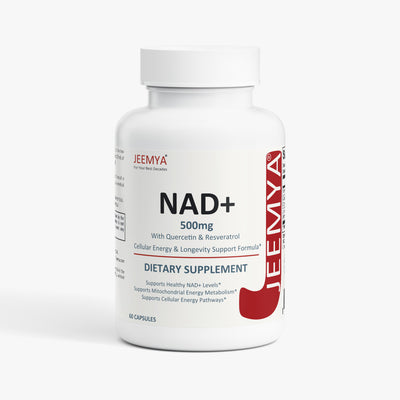
At Jeemya, we built our NAD+ 500 mg for people who already do the basics, eating well, moving often, and keeping nutrients like B12 in a healthy range, and want to support their energy where it is made. Each serving delivers 500 mg of NAD+, the coenzyme your mitochondria rely on to turn food into usable energy. It is made with clean ingredients, produced with GMP-minded standards, and labeled transparently so you know what you are taking. It is designed to support cellular energy production and healthy aging as part of your daily routine, not to replace a healthy diet or medical care. Research on oral NAD+ in people is still growing, so we encourage you to talk to your healthcare provider before adding it, especially if you take other medicines.
Looking for Science-Backed Metabolism Support? Explore Jeemya.
Getting enough B12 is a simple, low-cost way to make sure your metabolism is not held back. If you want more support for your energy and metabolic health, Jeemya offers daily formulas made with clean ingredients and transparent labels. Our NAD+ 500 mg supports cellular energy, and our Berberine HCl 800 mg supports healthy glucose metabolism. Every order comes with a 30-day money-back guarantee. Talk to your healthcare provider before starting any new supplement.
Frequently Asked Questions
Does B12 boost metabolism if I am not deficient?
No. B12 helps the enzymes that keep your energy pathways running, but once those enzymes have what they need, extra B12 does not raise your calorie burn. The NIH notes that B12 supplements do not appear to improve energy or endurance in people with enough B12.
Can low B12 make you gain weight?
Low B12 is linked with higher body weight in population studies, but that does not prove it causes weight gain. The NIH actually lists weight loss as a symptom of deficiency. Fatigue from low B12 may reduce your activity, which could affect weight over time.
Do B12 shots help you lose weight?
There is no solid evidence that B12 shots cause weight loss in people with normal levels. They are an effective treatment for B12 deficiency, especially pernicious anemia and deficiency after weight-loss surgery.
How do I know if I am low in B12?
A blood test is the only way to know. Your doctor may check serum B12 and, if results are borderline, methylmalonic acid (MMA). Signs that suggest testing include ongoing fatigue, pale skin, a sore tongue, tingling in the hands or feet, and memory changes.
Is methylcobalamin better than cyanocobalamin for metabolism?
There is no good evidence that one form works better for metabolism or weight. The NIH says absorption rates do not appear to vary by form. Cyanocobalamin is the most studied and most common form in supplements.
Should I take B12 if I take metformin?
Ask your doctor. Long-term metformin use raises the risk of B12 deficiency, and researchers from the Diabetes Prevention Program recommend considering routine B12 testing for people taking it. Your doctor can decide whether you need a supplement based on your results.
Can you take too much B12?
B12 has no official upper limit because it has low toxicity. However, one large observational study linked very high supplement use over 10 years with a higher lung cancer risk in men, so it is best to take only what you need.
References
- National Institutes of Health, Office of Dietary Supplements. Vitamin B12: Fact Sheet for Health Professionals. https://ods.od.nih.gov/factsheets/VitaminB12-HealthProfessional/
- Mayo Clinic Staff. Vitamin B-12 injections for weight loss: Do they work? Mayo Clinic. 2025. https://www.mayoclinic.org/healthy-lifestyle/weight-loss/expert-answers/vitamin-b12-injections/faq-20058145
- Sun Y, Sun M, Liu B, et al. Inverse association between serum vitamin B12 concentration and obesity among adults in the United States. Frontiers in Endocrinology. 2019;10:414. https://pmc.ncbi.nlm.nih.gov/articles/PMC6610317/
- Oliai Araghi S, Braun KVE, van der Velde N, et al. B-vitamins and body composition: integrating observational and experimental evidence from the B-PROOF study. European Journal of Nutrition. 2020. https://pmc.ncbi.nlm.nih.gov/articles/PMC7098930/
- Boachie J, Adaikalakoteswari A, Samavat J, Saravanan P. Low vitamin B12 and lipid metabolism: evidence from pre-clinical and clinical studies. Nutrients. 2020;12(7):1925. https://pmc.ncbi.nlm.nih.gov/articles/PMC7400011/
- Aroda VR, Edelstein SL, Goldberg RB, et al. Long-term metformin use and vitamin B12 deficiency in the Diabetes Prevention Program Outcomes Study. Journal of Clinical Endocrinology and Metabolism. 2016;101(4):1754-1761. https://pmc.ncbi.nlm.nih.gov/articles/PMC4880159/
- Wang H, Li L, Qin LL, et al. Oral vitamin B12 versus intramuscular vitamin B12 for vitamin B12 deficiency. Cochrane Database of Systematic Reviews. 2018;3:CD004655. https://pubmed.ncbi.nlm.nih.gov/29543316/
- Green R, Allen LH, Bjorke-Monsen AL, et al. Vitamin B12 deficiency. Nature Reviews Disease Primers. 2017;3:17040. https://pubmed.ncbi.nlm.nih.gov/28660890/
- Miller JW. Proton pump inhibitors, H2-receptor antagonists, metformin, and vitamin B-12 deficiency: clinical implications. Advances in Nutrition. 2018;9:511S-518S. https://pubmed.ncbi.nlm.nih.gov/30032223/
- Brasky TM, White E, Chen CL. Long-term, supplemental, one-carbon metabolism-related vitamin B use in relation to lung cancer risk in the Vitamins and Lifestyle (VITAL) cohort. Journal of Clinical Oncology. 2017;35(30):3440-3448. https://pubmed.ncbi.nlm.nih.gov/28829668/
- Amjad S, Nisar S, Bhat AA, et al. Role of NAD+ in regulating cellular and metabolic signaling pathways. Molecular Metabolism. 2021;101195. https://pmc.ncbi.nlm.nih.gov/articles/PMC7973386/
- Chini CCS, Cordeiro HS, Tran NLK, Chini EN. NAD metabolism: role in senescence regulation and aging. Aging Cell. 2023;e13920. https://pmc.ncbi.nlm.nih.gov/articles/PMC10776128/
Medical disclaimer: This article is for general information only and is not medical advice. It does not replace a consultation with a qualified healthcare provider. Talk to your doctor before making major changes to your diet or starting a new supplement, especially if you have a health condition, are pregnant or breastfeeding, or take medication.
0 comments