
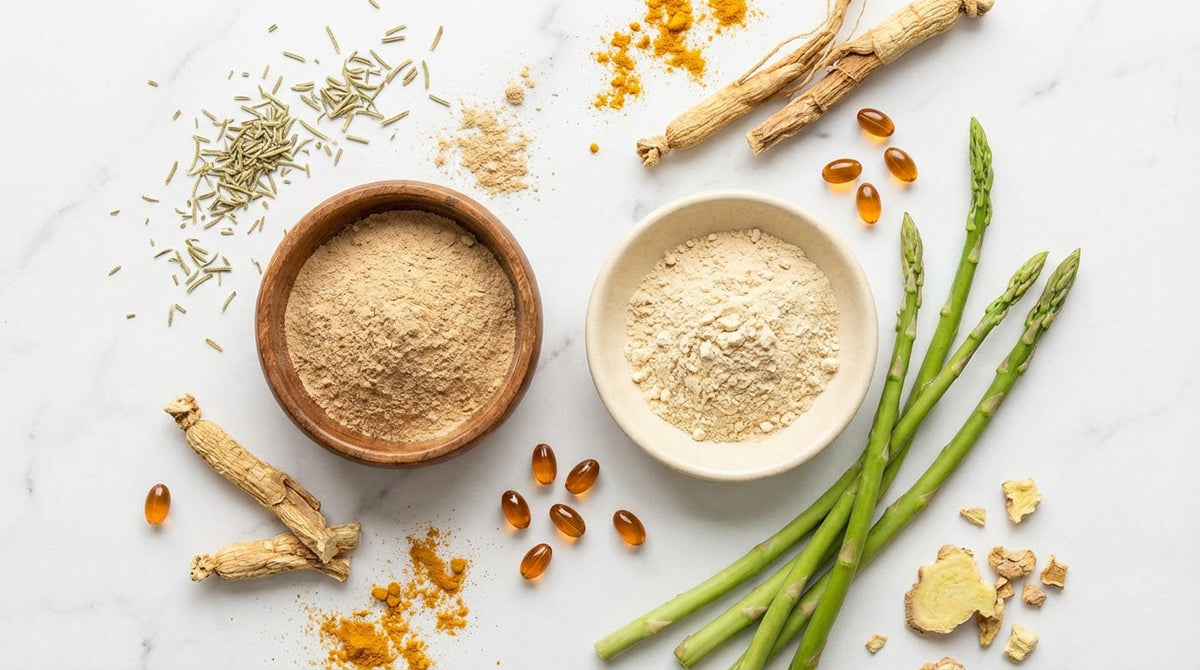
A supplement label tells you what's inside. It doesn't tell you what happens when those ingredients enter your body.
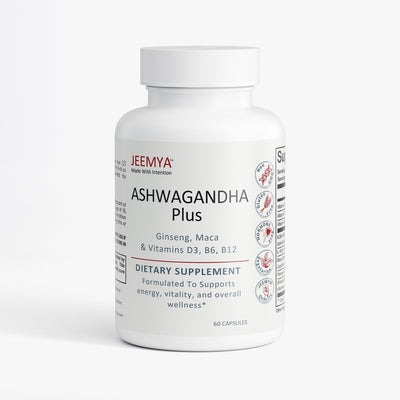
Jeemya Ashwagandha Plus contains eight active ingredients, each targeting a different system through a different mechanism. In this article, we'll break down every single one: what it is, how it works at the molecular level, which body systems it affects, and what the clinical research shows.
Ingredient 1: KSM-66® Ashwagandha Extract (600 mg)
Standardized to 5% Withanolides
What It Is
KSM-66 is a patented, full-spectrum extract from the root of Withania somnifera, the most clinically studied ashwagandha extract in the world, with 48+ published human trials. It uses a solvent-free, water-based extraction process that preserves the natural balance of all bioactive compounds.
The active compounds - withanolides - are steroidal lactones that modulate multiple biological pathways simultaneously.
How It Works in the Body
HPA Axis & Cortisol (Stress Response) Withanolides moderate the hypothalamic-pituitary-adrenal axis, the system that produces cortisol in response to stress. In a landmark 60-day RCT, 240 mg of ashwagandha extract reduced morning cortisol by 23%, while the placebo group showed a 0.5% increase (Lopresti et al., 2019). At 600 mg (the dose in Ashwagandha Plus), clinical trials show cortisol reductions of 22–33%.
GABAergic Signaling (Calm & Sleep) The aqueous root extract interacts with GABA-A receptors, the same system targeted by benzodiazepines, but without the sedative side effects. This promotes neural calm and supports sleep onset without daytime drowsiness.
NF-κB Inhibition (Inflammation) Withaferin A, a key withanolide, blocks NF-κB activation, reducing the production of pro-inflammatory cytokines TNF-α, IL-1β, and IL-6. This is significant because chronic stress and chronic inflammation are bidirectional: each amplifies the other.
Muscle & Testosterone (Physical Performance) At 600 mg/day with resistance training, KSM-66 has been shown to increase strength, muscle mass, and total testosterone in men within 12 weeks, likely through a combination of cortisol reduction (cortisol is catabolic) and direct anabolic signaling.
Key Research Finding
A 2025 meta-analysis of 15 RCTs (873 participants) confirmed ashwagandha significantly reduces cortisol (p < 0.0001), perceived stress (p = 0.001), and anxiety (p = 0.005) at 8 weeks of supplementation.
Ingredient 2: L-Arginine (300 mg)
What It Is
L-Arginine is a semi-essential amino acid, meaning your body produces it, but not always enough under stress, illness, or high physical demand.
How It Works in the Body
Nitric Oxide Production (Circulation) L-Arginine is the direct precursor to nitric oxide (NO), a signaling molecule that relaxes blood vessel walls (vasodilation). More NO means wider blood vessels, better blood flow, and more efficient delivery of oxygen and nutrients to muscles, organs, and the brain.
Exercise Performance By improving blood flow to working muscles, L-Arginine supports exercise capacity and recovery. It also participates in the urea cycle, helping the body process ammonia, a metabolic byproduct of intense exercise that contributes to fatigue.
Immune Function L-Arginine supports T-cell proliferation and is utilized by macrophages during immune responses. Under stress, arginine demand increases, making supplementation particularly relevant for stressed individuals.
Synergy with Ashwagandha
While ashwagandha reduces the hormonal stress response (cortisol), L-Arginine addresses one of cortisol's downstream effects: vasoconstriction. Chronic cortisol elevation constricts blood vessels. L-Arginine counteracts this by supporting NO-mediated vasodilation.
Ingredient 3: Maca Root Powder (150 mg)
Lepidium meyenii
What It Is
Maca is a cruciferous root vegetable from the Peruvian Andes, cultivated at 4,000+ meters altitude for over 2,000 years. It's classified as an adaptogen and is traditionally used for stamina, energy, and hormonal balance.
How It Works in the Body
Endocrine Support Unlike phytoestrogens, maca doesn't contain plant hormones. Instead, it appears to act on the hypothalamus and pituitary gland — the same control centers that ashwagandha modulates — supporting the body's own hormone production rather than introducing external hormones.
Energy & Stamina Clinical studies show maca can reduce perceived fatigue and improve subjective energy levels. The mechanism isn't fully elucidated but may involve improved mitochondrial function and enhanced oxygen utilization at altitude-adapted cellular pathways.
Libido & Sexual Function Multiple systematic reviews confirm maca's positive effects on sexual desire in both men and women. This appears to be independent of testosterone levels, suggesting a central nervous system mechanism rather than a purely hormonal one.
Synergy with Ashwagandha
Maca and ashwagandha target the same endocrine axis (hypothalamus-pituitary) through different compounds, creating complementary adaptogenic support without redundancy.
Ingredient 4: Panax Ginseng Powder (100 mg)
What It Is
Panax Ginseng (Korean/Asian Ginseng) is one of the most studied herbs in traditional medicine. Its active compounds - ginsenosides - are triterpene saponins with documented effects on energy, cognition, and immune function.
How It Works in the Body
Cognitive Performance Ginsenosides cross the blood-brain barrier and modulate neurotransmitter systems including acetylcholine, dopamine, and serotonin. Clinical trials show improvements in working memory, reaction time, and mental fatigue resistance.
Energy Metabolism Panax Ginseng enhances cellular energy production by supporting mitochondrial function and glucose uptake. Unlike caffeine, this produces sustained energy without jitteriness or crash.
Immune Modulation Ginsenosides stimulate natural killer (NK) cell activity and modulate T-cell and B-cell responses. This isn't "boosting" the immune system, it's calibrating it toward a more effective response.
Synergy with Ashwagandha
Ashwagandha reduces the energy drain caused by chronic cortisol; Panax Ginseng actively supports energy production at the cellular level. One removes the brake, the other adds fuel.
Ingredient 5: Shatavari Powder (50 mg)
Asparagus racemosus
What It Is
Shatavari is a species of asparagus revered in Ayurvedic medicine as the "Queen of Herbs." Its name translates to "she who possesses a hundred husbands", a reference to its traditional use for vitality and reproductive health.
How It Works in the Body
Adaptogenic Support Like ashwagandha and maca, Shatavari functions as an adaptogen, helping the body maintain homeostasis under stress. Its active compounds (steroidal saponins called shatavarins) modulate the stress response without stimulating or sedating.
Antioxidant Activity Shatavari root contains racemofuran and asparagamine A, compounds with documented free radical scavenging activity. This provides antioxidant support that complements the anti-inflammatory effects of ashwagandha's withanolides.
Digestive & Mucosal Support Shatavari has been shown to support the integrity of the gastrointestinal mucosa, the lining that protects your digestive tract. Chronic stress is known to compromise gut barrier function, making this a strategically relevant inclusion.
Ingredient 6: Vitamin D3, Cholecalciferol (20 mcg)
What It Is
The "sunshine vitamin", a fat-soluble secosteroid that functions more like a hormone than a traditional vitamin. An estimated 42% of American adults are deficient.
How It Works in the Body
Immune Regulation Vitamin D3 receptors exist on virtually every immune cell. D3 is required for the activation of T-cells, without adequate D3, T-cells remain in a dormant, naïve state and cannot mount an effective response to pathogens.
Mood & Neurological Function D3 receptors are concentrated in brain regions involved in mood regulation. Low vitamin D levels are consistently associated with higher rates of depression and anxiety in epidemiological studies.
Bone & Muscle D3 regulates calcium and phosphorus absorption, essential for bone mineralization and muscle contraction efficiency.
Synergy with Ashwagandha
Chronic cortisol elevation depletes vitamin D stores and suppresses immune function. Supplementing D3 alongside an HPA-modulating adaptogen addresses both the cause (excess cortisol) and the consequence (immune and mood vulnerability).
Ingredient 7: Vitamin B6, Pyridoxine (2.5 mg)
What It Is
A water-soluble vitamin essential for over 100 enzymatic reactions in the body.
How It Works in the Body
Neurotransmitter Synthesis B6 is a required cofactor for the synthesis of serotonin, dopamine, and GABA, the three neurotransmitters most directly involved in mood, motivation, and calm. Without adequate B6, your brain literally cannot produce enough of these chemicals.
Homocysteine Metabolism B6 helps convert homocysteine to cysteine, an important reaction because elevated homocysteine is a cardiovascular risk factor and is associated with cognitive decline.
Energy Metabolism B6 participates in glycogen breakdown and amino acid metabolism, supporting the body's ability to convert food into usable energy.
Synergy with Ashwagandha
Ashwagandha modulates GABA receptors; B6 ensures your body has the raw materials to produce GABA in the first place. This is upstream-downstream synergy.
Ingredient 8: Vitamin B12, Methylcobalamin (25 mcg)
What It Is
B12 in its most bioactive, methylated form, methylcobalamin. This is the form your nervous system uses directly, without requiring metabolic conversion.
How It Works in the Body
Nervous System Maintenance B12 is essential for myelin synthesis, the protective sheath around nerve fibers that enables fast, accurate signal transmission. Deficiency causes neurological symptoms including numbness, cognitive fog, and fatigue.
Red Blood Cell Formation B12 is required for DNA synthesis during red blood cell production. Deficiency leads to megaloblastic anemia, oversized, dysfunctional red blood cells that can't carry oxygen efficiently.
Energy Production B12 is a cofactor in the mitochondrial metabolism of fatty acids and amino acids, directly supporting cellular energy production.
How All 8 Ingredients Work Together
The architecture of Ashwagandha Plus isn't random. Each ingredient targets a specific bottleneck in the stress-energy-vitality chain:
|
System |
Problem Under Chronic Stress |
Ingredient Solution |
|---|---|---|
|
HPA Axis |
Overactivated, excess cortisol |
KSM-66 Ashwagandha, Maca, Shatavari |
|
Neurotransmitters |
Depleted serotonin, dopamine, GABA |
Vitamin B6 + Ashwagandha (GABA receptors) |
|
Circulation |
Cortisol-driven vasoconstriction |
L-Arginine (nitric oxide) |
|
Energy |
Mitochondrial suppression, fatigue |
Panax Ginseng, B12, B6 |
|
Immune System |
Cortisol-suppressed T-cell activation |
Vitamin D3 |
|
Inflammation |
NF-κB-driven chronic inflammation |
Ashwagandha (Withaferin A) + Shatavari |
|
Nervous System |
Myelin degradation, slow signaling |
B12 (Methylcobalamin) |
|
Endocrine Balance |
Disrupted hormone production |
Maca, Shatavari, Ashwagandha |
This is multi-pathway adaptogenic support, not a single-ingredient approach hoping one compound will fix everything.
Safety & Tolerability
Ashwagandha Plus uses clinically studied ingredients at established dosages. In published trials, KSM-66 at 600 mg/day has been well-tolerated for up to 12 weeks with only mild, occasional side effects (stomach upset, drowsiness).
Consult your healthcare provider if you:
-
Take thyroid medication (ashwagandha may affect TSH, T3, T4 levels)
-
Take immunosuppressants, sedatives, or diabetes medications
-
Are pregnant or nursing
-
Are under 18
The Bottom Line
Every ingredient in Ashwagandha Plus targets a specific mechanism:
-
KSM-66 Ashwagandha → cortisol reduction, GABA modulation, anti-inflammation, muscle support
-
L-Arginine → nitric oxide production, circulation, exercise recovery
-
Maca Root → endocrine support, stamina, libido
-
Panax Ginseng → cognitive performance, cellular energy, immune calibration
-
Shatavari → adaptogenic balance, antioxidant defense, gut mucosal support
-
Vitamin D3 → immune activation, mood regulation, bone health
-
Vitamin B6 → neurotransmitter synthesis (serotonin, dopamine, GABA)
-
Vitamin B12 → nervous system maintenance, energy metabolism, red blood cells
Together, they form a formula that addresses chronic stress from multiple angles — not just the hormone, but the cascade of systems it disrupts.
Adapt. Don't just endure.
References
-
Lopresti, A.L., et al. (2019). Stress-relieving and pharmacological actions of an ashwagandha extract. Medicine, 98(37), e17186.
-
Wankhede, S., et al. (2015). Effect of KSM-66 on muscle strength and recovery. JISSN, 12, 43.
-
Bonilla, D.A., et al. (2023). Effects of Withania somnifera on Cortisol Levels. Nutrients, 15(24), 5035.
-
Zahiruddin, S., et al. (2024). Ashwagandha's Multifaceted Effects on Human Health. IJMS.
-
NIH ODS (2026). Ashwagandha — Health Professional Fact Sheet.
-
Gonzales, G.F. (2012). Ethnobiology and Ethnopharmacology of Lepidium meyenii (Maca). Evidence-Based Complementary and Alternative Medicine.
-
Reay, J.L., et al. (2010). Panax ginseng and cognitive function. Psychopharmacology.
-
Alok, S., et al. (2013). Plant profile, phytochemistry and pharmacology of Asparagus racemosus (Shatavari). Asian Pacific Journal of Tropical Disease.
These statements have not been evaluated by the Food and Drug Administration. This product is not intended to diagnose, treat, cure, or prevent any disease. Always consult your healthcare provider before starting any new supplement regimen.
0 comments