
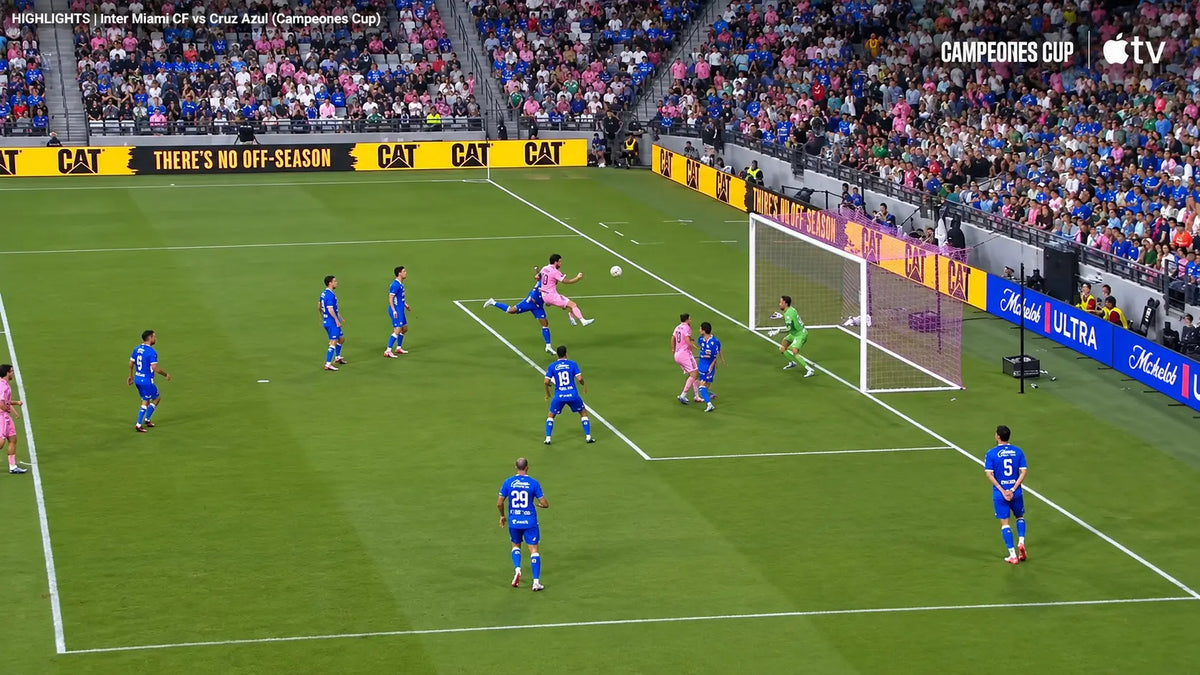
Inter Miami vs Cruz Azul was billed as a rematch three years in the making — and it delivered. Inter Miami beat Cruz Azul 2–0 to win the 2026 Campeones Cup, with Lionel Messi scoring his 100th goal for the club at 39 years old. Here's a full recap of the Inter Miami - Cruz Azul final, why the milestone matters, and what the science of cellular energy and NAD+ can — and can't — tell us about staying at the top of your game as you age.
Inter Miami vs Cruz Azul: Campeones Cup Final Recap
On September 16, 2026, Inter Miami hosted Cruz Azul at Nu Stadium in Miami for the 2026 Campeones Cup — the annual, winner-takes-all match between the reigning MLS champion and the reigning Liga MX champion. Inter Miami came in as MLS Cup holders; Cruz Azul arrived as champions of Liga MX's Clausura and the recent Campeón de Campeones, and looking for revenge after a painful history against the Herons.
The Inter Miami vs. Cruz Azul final went to the home side, 2–0. Lionel Messi opened the scoring in the 24th minute, rising to head in a cross from Luis Suárez. Cruz Azul pushed for an equalizer through the second half, but Inter Miami held firm, and Casemiro sealed the win in the 81st minute with a header from a corner kick — delivered by Messi himself. The result gave Inter Miami its first Campeones Cup title, added another trophy to the club's growing collection, and handed new head coach Cristian "Kily" González a winning start to his tenure.
For a match that many expected to be tight, Miami vs Cruz Azul — or Cruz Azul vs Miami, depending on which side of the border you're rooting for — turned into a comfortable, well-controlled performance from the hosts, but the real headline of the night had nothing to do with the final score.
Cruz Azul vs Inter Miami: A Rematch Three Years in the Making
This was only the second official meeting between Cruz Azul and Inter Miami. The first came on July 21, 2023, in the group stage of the inaugural Leagues Cup — a match remembered as Lionel Messi's dramatic debut for the club. Messi and Sergio Busquets came on as second-half substitutes that night, and Messi settled a 1–1 game with a stoppage-time free kick to win it 2–1. That single goal against Cruz Azul launched a run that ended with Inter Miami lifting the Leagues Cup trophy in Messi's first weeks in Major League Soccer.
Three years later, the Cruz Azul vs Inter Miami storyline came full circle. Messi's 100th goal for the club, scored in the Campeones Cup final, came against the very same opponent he scored his first goal against — a detail that made the milestone even more fitting for a rivalry that, on paper, has only met twice.
Why the Campeones Cup Win Matters for Inter Miami
The Campeones Cup itself isn't sanctioned by CONCACAF or FIFA, and it carries a modest prize purse compared to league or continental titles. But for Inter Miami — and for Inter de Miami's fanbase — beating Cruz Azul to lift the trophy carried real significance. It was the first trophy won at Nu Stadium, the club's new home since opening in April 2026, and it extended an unusual streak: Inter Miami has not had a season with Messi on the roster in which the club failed to win at least one trophy, following the Leagues Cup, the Supporters' Shield, and the 2025 MLS Cup.
It was also a strong response to a difficult stretch of results for Miami heading into the match, and a statement result for a new coaching staff taking charge of a squad still built around Messi, Suárez, Busquets, and new arrival Casemiro.
How Old Is Lionel Messi, and Why Does That Matter Here?
Lionel Messi turned 39 in the summer of 2026, an age at which most professional footballers have already retired from top-flight competition. Elite football is a young athlete's sport by design: sprint speed, joint recovery, and match-to-match freshness all tend to decline through a player's thirties. Messi is one of a small handful of players in the sport's history to remain a decisive, match-winning presence this deep into a career — and his performance in the Inter Miami vs Cruz Azul final was a clear example of that.
It's not just that Messi is still playing at 39 — it's that he's still producing: still scoring, still creating (his corner set up Casemiro's goal), still recovering fast enough to do it again days later. From a physiological standpoint, that combination is unusual enough to be genuinely interesting, independent of any product or supplement conversation.
Messi's 100th Inter Miami Goal: Why the Milestone Matters
Messi's header against Cruz Azul brought his tally to exactly 100 goals for Inter Miami in 115 appearances across all competitions — a rate that puts him among the most productive attacking players MLS has ever seen, at an age when goal output for most players is already in decline. The scoreline and the statistics from the Inter Miami - Cruz Azul match are one story. The more interesting question, from a health and performance perspective, is different: what does it take for the body to sustain this level of output at an age when most athletes have long since stepped away?
That question is where the science of aging, cellular energy, and recovery comes in — and it's a much bigger, more useful conversation than any single match result, whether it's Inter Miami vs. Cruz Azul or any other fixture on the calendar.
What Happens to Cellular Energy as We Age?
Every cell in the human body needs a constant, moment-to-moment supply of usable energy to function — to contract a muscle fiber, repair damaged tissue, or simply keep basic housekeeping processes running. That energy is generated primarily in the mitochondria, the small structures inside cells often described as the body's "power plants."
As we age, several things tend to happen at the cellular level:
- Mitochondrial efficiency declines. Mitochondria become less effective at converting nutrients into usable energy, and their overall number per cell can decrease.
- Cellular repair and recovery slow down. The processes that repair micro-damage from exercise, sun exposure, and everyday metabolic stress become less efficient.
- Levels of certain key coenzymes drop. Chief among these is NAD+ (nicotinamide adenine dinucleotide), a molecule that nearly every energy-producing and repair process in the body depends on.
None of this is unique to athletes — it's a universal part of human aging. What makes elite athletes like the ones on display in the Inter Miami vs Cruz Azul final a useful case study is that their bodies are placed under repeated, measurable physical stress, which makes the effects of age on energy production and recovery much more visible than they would be in a sedentary lifestyle.
What Is NAD+ and Why Does the Body Need It?
NAD+ is a coenzyme found in every living cell. It plays a central role in two categories of processes directly relevant to physical performance and long-term health:
- Energy metabolism. NAD+ is essential to the mitochondrial pathways that convert food into ATP, the molecule cells use as fuel. Without adequate NAD+, this conversion becomes less efficient.
- Cellular repair and regulation. NAD+ is a required co-substrate for enzyme families such as sirtuins and PARPs, which are involved in DNA repair, inflammation control, and the regulation of cellular stress responses.
Research over the past two decades has consistently shown that NAD+ levels decline with age across multiple tissue types, including skeletal muscle. This decline is one of the reasons NAD+ metabolism has become a major area of interest within aging and longevity research — not as a single "fountain of youth" molecule, but as one measurable piece of a much larger picture of how cells lose efficiency over time.
Does Exercise Affect NAD+ Metabolism?
Exercise and NAD+ metabolism are closely linked. Physical activity — particularly sustained aerobic effort and high-intensity exercise — increases the metabolic demand placed on muscle cells, which in turn increases the turnover of NAD+ and related enzymes. Regular training has also been associated with improvements in mitochondrial density and function, partly through pathways connected to NAD+-dependent signaling.
This is one reason exercise itself remains, by a wide margin, the best-studied intervention for supporting healthy cellular energy metabolism as people age. It isn't a coincidence that elite athletes who train and compete at a high volume for decades — as Messi has, right up through matches like Inter Miami vs Cruz Azul — provide such a visible example of sustained physical capacity: consistent training is itself one of the strongest known levers for supporting mitochondrial and metabolic health.
NAD+ and Muscle Energy: What Human Research Shows
Human studies on NAD+ metabolism and exercise are still an active and evolving area of research. Some of the consistent findings include:
- Skeletal muscle NAD+ levels tend to be lower in older adults compared with younger adults.
- Acute bouts of exercise have been shown to influence NAD+-related enzyme activity, including in peripheral blood cells, suggesting the body's NAD+ metabolism responds dynamically to physical stress.
- Trained individuals often show different NAD+-pathway markers compared with untrained individuals of a similar age, though research in this area is ongoing and results vary by study design, population, and exercise type.
It's important to be precise about what this research does and doesn't show. It demonstrates that NAD+ metabolism is responsive to exercise and tends to decline with age — it does not demonstrate that any single supplement, including NAD+ precursors, replicates the effect of training, or that any specific athlete's performance in a match like Inter Miami vs Cruz Azul is attributable to a particular product. That distinction matters, and it's one that gets lost in a lot of consumer health content.
Can NAD+ Supplements Support Healthy Aging?
Because NAD+ itself is broken down before it can be absorbed intact through the digestive system, most NAD+-focused supplements are built around NAD+ precursors — molecules the body can use to synthesize NAD+ internally — or ingredients studied for their role in supporting the broader pathways NAD+ depends on.
Early-stage human research on NAD+ precursor supplementation has looked at outcomes such as:
- Changes in blood NAD+ levels following supplementation
- Markers of mitochondrial function
- Measures of physical performance and fatigue in specific populations
The research base is genuinely promising but still developing. Most published human trials are small, short-term, or focused on specific populations (such as older adults or people with particular metabolic conditions), rather than elite athletes. Anyone evaluating an NAD+ supplement should treat it the way they'd treat any longevity-adjacent product: as a potential complement to established healthy-aging habits, not a substitute for them, and not a guarantee of any particular outcome.
NAD+ vs. Exercise: Can Supplements Replace Physical Activity?
No — and no credible NAD+ research suggests otherwise. Exercise remains the most extensively validated way to support mitochondrial density, insulin sensitivity, cardiovascular health, and cellular resilience as we age. NAD+ status is one measurable factor within that larger system, not a shortcut around it.
The more accurate way to frame the relationship is this: exercise appears to help the body maintain and use NAD+ more effectively, and adequate NAD+ availability appears to support the cellular processes that exercise relies on. They work in the same direction, not as substitutes for each other.
This is also why a performance like Messi's in the Inter Miami vs Cruz Azul final is a compelling illustration of healthy aging principles rather than proof of any specific product's effect. An athlete's longevity reflects decades of training load, recovery discipline, nutrition, and — inevitably — some genetic and circumstantial advantage. Cellular energy metabolism is one thread in that story, not the whole explanation.
What to Look for in an NAD+ Supplement
If you're evaluating NAD+ supplements as part of a broader healthy-aging or recovery-support routine, a few practical criteria are worth applying:
- Transparent dosing. Look for a supplement that discloses exact milligram amounts for every active ingredient, not proprietary blends.
- Third-party or ingredient-level quality standards. Standardized extracts (for example, resveratrol standardized to a specific percentage) offer more consistency than generic plant extracts.
- Complementary ingredients with a clear rationale. Ingredients like quercetin and resveratrol are often paired with NAD+ precursors because of their studied roles in cellular senescence and antioxidant support — the formulation logic should be explainable, not just marketed.
- Realistic claims. Be cautious of any brand implying a supplement alone will replicate the effects of training, or that ties its product to a specific celebrity or athlete's performance — including a match like Inter Miami vs. Cruz Azul — without evidence.
The Bottom Line
The Inter Miami vs Cruz Azul Campeones Cup final gave football fans a 2–0 win, a first trophy at Nu Stadium, and a genuinely remarkable milestone: Messi's 100th goal for Inter Miami, scored at 39 years old against the same opponent he scored his first Inter Miami goal against back in 2023. That milestone is not evidence for any supplement, including NAD+ products, and no credible brand should claim otherwise. What it does offer is a vivid, real-world entry point into a legitimate and still-developing area of science: how cellular energy metabolism changes as we age, why NAD+ is one of the molecules researchers are watching closely, and what that means for anyone — athlete or not — thinking seriously about long-term recovery and healthy aging.
This article is for informational purposes only and does not constitute medical advice. NAD+ supplements have not been evaluated for the treatment of any medical condition, and individual results vary. Consult a healthcare provider before starting any new supplement.
0 comments