Your joints absorb between 3 and 6 times your body weight with every step you take. Over a lifetime, that's millions of impact cycles on the cartilage, synovial fluid, and connective tissue that keep you moving without pain. When these structures degrade - through wear, inflammation, or nutritional deficiency - the result is stiffness, discomfort, and reduced mobility.
Most joint supplements target one mechanism: either inflammation or cartilage. That's insufficient. Joint health depends on multiple systems working simultaneously, cartilage structure, synovial lubrication, inflammatory regulation, and connective tissue integrity.
This article explains how joints actually work, what causes them to deteriorate, and how each ingredient in a multi-pathway joint formula addresses a different layer of the problem.
How Your Joints Actually Work
The Four Structural Systems
1. Articular Cartilage A smooth, resilient tissue that covers the ends of bones where they meet. Cartilage absorbs shock, distributes load, and provides a near-frictionless surface for movement. It's composed primarily of collagen (type II), proteoglycans (including glucosamine and chondroitin), and water. Cartilage has no blood supply, it receives nutrients through synovial fluid.
2. Synovial Fluid A viscous liquid that fills the joint capsule. It serves two functions: lubrication (reducing friction between cartilage surfaces) and nutrition (delivering oxygen and nutrients to cartilage). Hyaluronic acid is the primary component that gives synovial fluid its viscosity.
3. Connective Tissue (Ligaments & Tendons) Ligaments connect bone to bone. Tendons connect muscle to bone. Both are collagen-rich structures that depend on sulfur compounds like MSM for cross-linking and structural integrity.
4. Inflammatory Regulation Controlled inflammation is how the body repairs tissue. Chronic inflammation, however, actively destroys cartilage by upregulating matrix metalloproteinases (MMPs), enzymes that break down collagen and proteoglycans faster than the body can rebuild them.
What Goes Wrong
Joint deterioration follows a predictable cascade: chronic low-grade inflammation → elevated MMPs → cartilage matrix breakdown → reduced synovial fluid quality → bone-on-bone contact → pain and stiffness. By the time you feel it, the process has been underway for years.
Effective joint support must interrupt this cascade at multiple points, not just mask pain.
Ingredient 1: MSM, Methylsulfonylmethane
System: Connective Tissue + Inflammatory Regulation
What It Is
MSM is an organic sulfur compound found naturally in plants, animals, and humans. Sulfur is the third most abundant mineral in the human body and is essential for the formation of connective tissue, particularly collagen and keratin.
How It Works in the Body
Sulfur Donor for Collagen Synthesis Collagen - the structural protein in cartilage, tendons, and ligaments - requires sulfur for cross-linking. These disulfide bonds are what give collagen its tensile strength. MSM provides bioavailable sulfur that supports the body's ability to synthesise and repair collagen-rich structures.
Anti-Inflammatory Action MSM inhibits NF-κB activation - the master transcription factor that drives chronic inflammatory gene expression. By reducing NF-κB signalling, MSM helps lower the production of pro-inflammatory cytokines (IL-6, TNF-α) and MMPs that degrade cartilage.
Antioxidant Support MSM enhances the body's production of glutathione - the most important intracellular antioxidant. Oxidative stress in joint tissue accelerates cartilage breakdown; glutathione neutralises the reactive oxygen species responsible.
Key Research Finding
A 2023 randomised, double-blind study (88 participants) found that daily MSM supplementation for 12 weeks significantly improved knee discomfort compared to placebo. A separate study found MSM-glucosamine-chondroitin combinations improved joint health more effectively than glucosamine and chondroitin alone (AARP, 2025).
Ingredient 2: GlucosaGreen® Vegetal Glucosamine HCl
System: Cartilage Structure
What It Is
GlucosaGreen® is a patented, plant-derived glucosamine hydrochloride made from fermented corn, not shellfish. This makes it suitable for people with shellfish allergies and for vegetarian/vegan diets. Glucosamine is a naturally occurring amino sugar that serves as a fundamental building block of cartilage.
How It Works in the Body
Glycosaminoglycan (GAG) Precursor Glucosamine is the direct precursor to glycosaminoglycans, the molecular chains that form proteoglycans in cartilage. Proteoglycans trap water within the cartilage matrix, giving it the shock-absorbing, compressive resilience that protects bone ends during movement.
Cartilage Matrix Protection Glucosamine has been shown to inhibit matrix metalloproteinases (MMPs) and aggrecanases, the enzymes that break down cartilage components. It also stimulates the production of aggrecan and type II collagen, actively rebuilding the cartilage matrix.
Anti-Inflammatory Properties Glucosamine inhibits phospholipase A2 - an enzyme in the inflammatory cascade - helping reduce local joint inflammation without the gastrointestinal side effects associated with NSAIDs.
Key Research Finding
A 2025 systematic review (PMC, 146 studies) found that over 90% of efficacy studies reported positive outcomes for glucosamine in osteoarthritis and joint pain, with most safety studies indicating minimal or no adverse effects. The combination of glucosamine with other joint compounds showed synergistic benefits.
Ingredient 3: Turmeric Powder (Root)
System: Inflammatory Regulation
What It Is
Turmeric (Curcuma longa) is a rhizome whose primary bioactive compound - curcumin - is one of the most studied anti-inflammatory agents in natural medicine. Curcumin gives turmeric its characteristic golden colour and its therapeutic properties.
How It Works in the Body
Multi-Pathway Inflammation Modulation Curcumin inhibits both COX-2 (cyclooxygenase-2) and LOX (lipoxygenase) enzymes — the same pathways targeted by NSAIDs and corticosteroids. It also suppresses NF-κB, reducing the transcription of inflammatory genes. This multi-pathway action makes curcumin exceptionally broad-spectrum as an anti-inflammatory.
MMP Inhibition By reducing NF-κB-driven inflammation, curcumin indirectly reduces MMP production, slowing the enzymatic breakdown of cartilage collagen and proteoglycans.
Antioxidant Protection Curcumin neutralises free radicals and upregulates the body's own antioxidant enzymes (superoxide dismutase, catalase, glutathione peroxidase), protecting joint tissue from oxidative damage.
Key Research Finding
A 2021 review of 10 high-quality studies published in BMJ Open Sport & Exercise Medicine found turmeric/curcumin reduced pain and improved function in knee osteoarthritis. Three studies comparing turmeric directly with NSAIDs found equivalent effectiveness, without the gastrointestinal side effects.
Ingredient 4: Boswellia Serrata Extract (65% Boswellic Acids)
System: Inflammatory Regulation + Cartilage Protection
What It Is
Boswellia serrata is a tree native to India whose resin produces boswellic acids, triterpene compounds with potent, specific anti-inflammatory activity. This extract is standardised to 65% boswellic acids for maximum potency.
How It Works in the Body
5-Lipoxygenase (5-LOX) Inhibition Boswellic acids are specific inhibitors of 5-lipoxygenase, the enzyme that produces leukotrienes, a class of pro-inflammatory mediators distinct from the prostaglandins targeted by NSAIDs. This gives Boswellia a complementary anti-inflammatory mechanism to turmeric's COX/LOX inhibition.
Direct MMP Suppression AKBA (acetyl-11-keto-β-boswellic acid), the most potent boswellic acid, directly inhibits MMP-3 and MMP-9, enzymes that degrade cartilage matrix proteins. This provides cartilage protection beyond inflammation reduction alone.
Key Research Finding
A 2025 review and meta-analysis found Aflapin (a Boswellia serrata extract) to be the most effective supplement for reducing joint pain and one of the top three for relieving stiffness among all joint supplements studied (AARP/Arthritis Foundation, 2025).
Ingredient 5: White Willow Bark Extract
System: Pain & Inflammatory Modulation
What It Is
White willow bark (Salix alba) is the original source of salicin, the compound that inspired the development of aspirin. Unlike synthetic aspirin, willow bark delivers salicin alongside flavonoids and polyphenols that contribute to a broader, gentler anti-inflammatory profile.
How It Works in the Body
Salicin is metabolised in the gut and liver to salicylic acid, an inhibitor of COX-1 and COX-2 enzymes. This reduces prostaglandin synthesis, providing analgesic and anti-inflammatory effects. The slower metabolic conversion (compared to aspirin) produces a more gradual onset with fewer gastrointestinal side effects.
Ingredient 6: Hyaluronic Acid
System: Synovial Lubrication
What It Is
Hyaluronic acid (HA) is a glycosaminoglycan naturally present in synovial fluid, cartilage, and connective tissue. It's the primary molecule responsible for synovial fluid viscosity.
How It Works in the Body
Oral HA supplementation has been shown to increase synovial fluid HA concentration, improving joint lubrication and shock absorption. HA also supports cartilage hydration - keeping the matrix supple and resilient - and has demonstrated anti-inflammatory effects by modulating cytokine production in joint tissue.
Ingredient 7: Black Pepper Extract (95% Piperine)
System: Bioavailability
What It Is
Piperine from Piper nigrum, standardised to 95% purity, included specifically to enhance the absorption of curcumin (from turmeric) and other active compounds.
How It Works
Curcumin's primary limitation is poor bioavailability, it's rapidly metabolised and eliminated. Piperine inhibits CYP3A4 and glucuronidation enzymes, increasing curcumin bioavailability by up to 2,000%. It also enhances absorption of MSM and other fat-soluble compounds.
How All Seven Ingredients Work Together
|
Joint Need |
Problem |
Joint Support Solution |
|---|---|---|
|
Cartilage Rebuilding |
Degraded proteoglycans and collagen |
Glucosamine (GAG precursor) + MSM (sulfur for collagen) |
|
Inflammation Control |
Chronic NF-κB / COX / LOX activation |
Turmeric (COX/LOX) + Boswellia (5-LOX) + MSM (NF-κB) |
|
Enzyme Suppression |
Elevated MMPs destroying cartilage |
Boswellia (MMP-3/9) + Glucosamine (MMP inhibition) + Curcumin |
|
Synovial Lubrication |
Thin, degraded synovial fluid |
Hyaluronic Acid (viscosity restoration) |
|
Pain Relief |
Prostaglandin-mediated joint pain |
White Willow Bark (salicin → salicylic acid) + Turmeric |
|
Oxidative Protection |
Free radical damage to joint tissue |
MSM (glutathione) + Curcumin (antioxidant enzymes) |
|
Ingredient Absorption |
Poor curcumin bioavailability |
Black Pepper Extract (2,000% increase) |
This is multi-layer joint architecture — not a single-ingredient approach.
Who Benefits Most
-
Adults 40+ experiencing age-related joint stiffness or reduced mobility
-
Active individuals and athletes whose joints absorb repetitive impact stress
-
Anyone with occasional joint discomfort from overuse, weather changes, or prolonged sitting
-
People seeking NSAID alternatives who want anti-inflammatory support without gastrointestinal risk
-
Individuals focused on prevention who want to support cartilage maintenance before problems develop
Safety & Usage
Dosage: 2 capsules daily with 6–8 oz water. Form: 60 capsules (30 servings) | $29.90 Made in USA | GlucosaGreen® vegetal glucosamine (shellfish-free)
Consult your healthcare provider if you: take blood thinners (willow bark, turmeric may interact); take NSAIDs or acetaminophen; are pregnant or nursing; are under 18.
Frequently Asked Questions
How long until I notice results?
Anti-inflammatory ingredients (turmeric, boswellia, MSM) may provide comfort within 2–4 weeks. Structural support ingredients (glucosamine, hyaluronic acid) typically require 8–12 weeks of consistent daily use for full effect, as cartilage turnover is a slow process.
Is the glucosamine shellfish-free?
Yes. Jeemya uses GlucosaGreen®, a patented vegetal glucosamine derived from fermented corn, not shellfish. It's suitable for people with shellfish allergies.
Can I take this with other supplements?
Yes. Joint Support is compatible with most supplement regimens. However, consult your healthcare provider if you take blood thinners, as turmeric, boswellia, and willow bark may have mild anticoagulant effects.
Is this the same as taking turmeric alone?
No. Turmeric addresses inflammation only. This formula simultaneously supports cartilage rebuilding (glucosamine), connective tissue integrity (MSM), synovial lubrication (hyaluronic acid), multi-pathway inflammation control (turmeric + boswellia + willow bark), and bioavailability (piperine). Single-ingredient approaches miss most of the joint health equation.
The Bottom Line
Joint Support delivers across five simultaneous systems:
-
Cartilage structure - GlucosaGreen® glucosamine + MSM
-
Inflammatory regulation - Turmeric + Boswellia (65% boswellic acids) + White Willow Bark
-
Synovial lubrication - Hyaluronic Acid
-
Connective tissue integrity - MSM (sulfur for collagen cross-linking)
-
Bioavailability — Black Pepper Extract (95% piperine)
Structure before comfort. Architecture before relief.
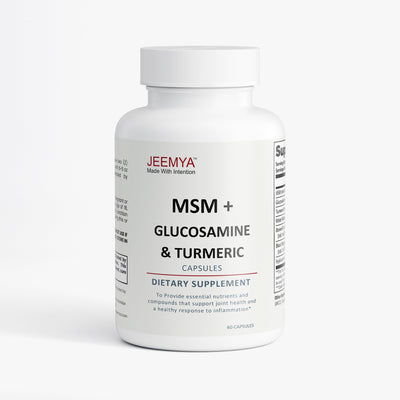
→ Try Jeemya MSM + Glucosamine & Turmeric Joint Support
References
-
PMC (2025). The Safety and Efficacy of Glucosamine and/or Chondroitin in Humans — Systematic Review. PMC, 146 studies.
-
Daily, J.W., et al. (2016). Efficacy of turmeric extracts and curcumin for alleviating symptoms of joint arthritis. Journal of Medicinal Food, 19(8), 717–729.
-
Debbi, E.M., et al. (2011). Efficacy of MSM supplementation on osteoarthritis of the knee. BMC Complementary and Alternative Medicine, 11, 50.
-
Sengupta, K., et al. (2008). A double-blind, randomized, placebo-controlled study of Aflapin. International Journal of Medical Sciences, 5(6), 366–377.
-
Shoba, G., et al. (1998). Influence of piperine on the pharmacokinetics of curcumin. Planta Medica, 64(4), 353–356.
-
NCCIH (2026). Glucosamine and Chondroitin for Osteoarthritis — What You Need To Know.
These statements have not been evaluated by the Food and Drug Administration. This product is not intended to diagnose, treat, cure, or prevent any disease. Always consult your healthcare provider before starting any new supplement regimen.