Stress isn't just a feeling. It's a measurable biochemical cascade, one that starts in your brain, travels through your endocrine system, and ends with cortisol flooding your bloodstream. When that cascade fires too often or never fully shuts off, everything from your sleep to your metabolism to your immune system pays the price.
Ashwagandha is one of the most clinically studied natural compounds for interrupting that cycle. Not by masking symptoms, but by modulating the system that produces them.
This article explains exactly what ashwagandha is, how it works at the hormonal level, what the clinical evidence shows, and who stands to benefit most.
What Is Ashwagandha?
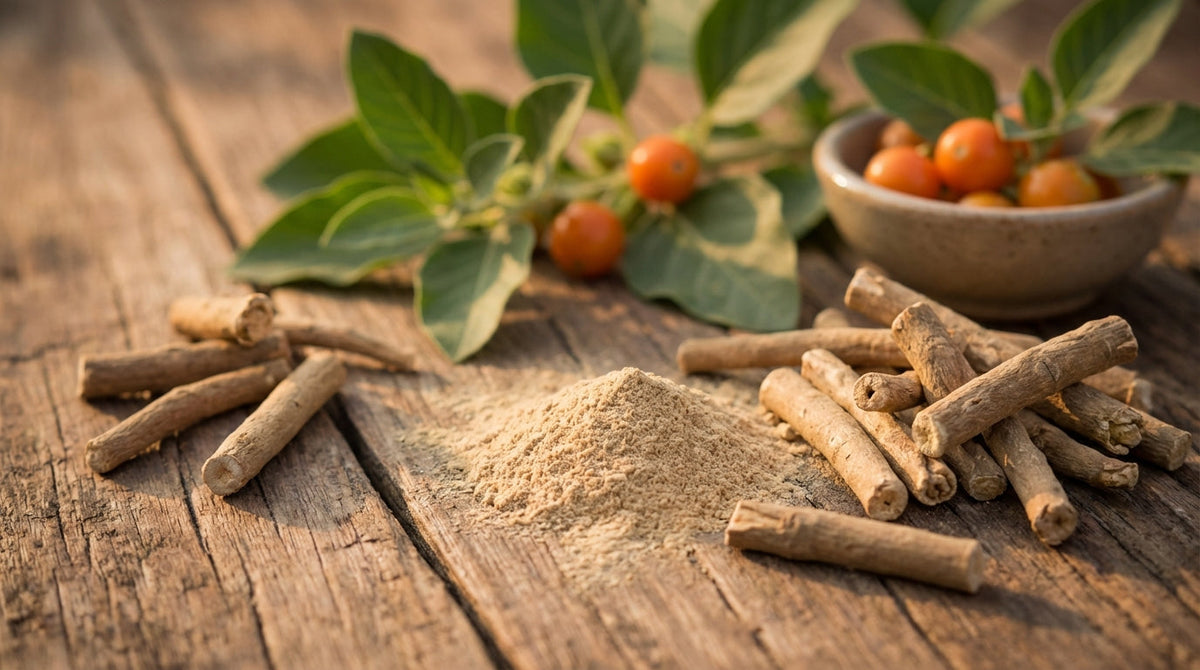
Ashwagandha (Withania somnifera) is a small evergreen shrub native to India, the Middle East, and parts of Africa. It has been used in Ayurvedic medicine for over 3,000 years — the species name somnifera literally means "sleep-inducing" in Latin.
The plant belongs to a class of compounds called adaptogens, natural substances that help the body adapt to stress and restore balance. Unlike stimulants or sedatives, adaptogens don't push your system in one direction. They help calibrate it.
The primary bioactive compounds in ashwagandha are withanolides, a group of naturally occurring steroidal lactones concentrated mainly in the root. Withanolides are responsible for most of ashwagandha's documented effects on stress, cortisol, sleep, and cognitive function.
How Ashwagandha Works: The HPA Axis
To understand ashwagandha, you need to understand the HPA axis, the hypothalamic-pituitary-adrenal axis. This is the body's central stress response system.
The Stress Cascade
-
Hypothalamus detects a stressor → releases CRH (corticotropin-releasing hormone)
-
Pituitary gland receives CRH → releases ACTH (adrenocorticotropic hormone) into the bloodstream
-
Adrenal cortex receives ACTH → produces cortisol and releases it into circulation
-
Cortisol triggers "fight or flight" responses: increased heart rate, elevated blood sugar, suppressed digestion, heightened alertness
-
A negative feedback loop is supposed to shut this cascade down once the stressor passes
The problem: in modern life, the stressor rarely passes. Work pressure, financial stress, sleep deprivation, and information overload keep the HPA axis chronically activated. Cortisol stays elevated. The feedback loop weakens.
Where Ashwagandha Intervenes
Ashwagandha's withanolides appear to work through multiple mechanisms:
1. HPA Axis Modulation
Research indicates that withanolides have a moderating effect on HPA axis activity. In a 60-day randomized, double-blind, placebo-controlled trial, ashwagandha supplementation reduced morning cortisol by 23% compared to a 0.5% increase in the placebo group (Lopresti et al., 2019).
2. GABAergic Activity
Preclinical studies show that aqueous ashwagandha root extract interacts with GABA receptors — the same receptors targeted by anti-anxiety medications. GABA is the brain's primary inhibitory neurotransmitter, responsible for calming neural activity.
3. Anti-Inflammatory Pathways
Withaferin A, one of the most studied withanolides, inhibits NF-κB, a master regulator of inflammation. Since chronic stress increases systemic inflammation, and inflammation itself amplifies cortisol resistance, this creates a secondary pathway for stress reduction.
4. Serotonin Modulation
Animal studies suggest ashwagandha can influence serotonergic activity, supporting mood regulation alongside its cortisol-lowering effects.
What the Clinical Evidence Shows
Ashwagandha - particularly the KSM-66 extract - is one of the most clinically studied adaptogens in the world, with 48+ double-blind, randomized, placebo-controlled trials.
Stress & Anxiety Reduction
A 2025 systematic review and meta-analysis (15 studies, 873 participants) published in BJPsych Open found:
-
Significant reduction in anxiety on the Hamilton Anxiety Rating Scale (HAM-A): μ = −3.52 at 8 weeks (p = 0.005)
-
Significant reduction in perceived stress on the PSS scale: μ = −4.88 at 8 weeks (p = 0.001)
-
Significant reduction in cortisol levels: μ = −2.36 (p < 0.0001)
The World Federation of Societies of Biological Psychiatry (WFSBP) and the Canadian Network for Mood and Anxiety Treatments (CANMAT) now provisionally recommend 300–600 mg/day of ashwagandha root extract (standardized to 5% withanolides) for generalized anxiety disorder.
Cortisol Reduction
Across 9 clinical trials reviewed in a 2023 systematic review (Nutrients), ashwagandha supplementation reduced plasma cortisol by 11% to 32.6% from baseline in stressed individuals, with a clear dose-response relationship:
|
Daily Dose |
Cortisol Reduction |
|---|---|
|
125 mg twice daily |
16.5% |
|
300 mg twice daily |
32.6% |
|
240 mg once daily (35% withanolides) |
23% |
|
300 mg once daily |
29.9% |
Sleep Quality
In a trial of 150 adults with sleep problems, ashwagandha improved sleep quality in 72% of participants compared to 29% in the placebo group. An 8-week KSM-66 trial confirmed improvements in sleep onset latency, sleep quality, and mental alertness upon waking — particularly in participants with insomnia.
Physical Performance
KSM-66 at 600 mg/day combined with resistance training for 12 weeks resulted in:
-
Increased bench press and leg extension strength
-
Increased muscle size (chest and arm measurements)
-
Improved body fat composition compared to placebo
-
Increased total testosterone within the normal healthy range
Cognitive Function
Multiple trials report improvements in memory, focus, multitasking ability, and psychological well-being. Participants consistently describe their stress as "more manageable" compared to placebo groups.
KSM-66: Why the Extract Matters
Not all ashwagandha supplements are equivalent. The extract type determines potency, consistency, and clinical relevance.
KSM-66 is a branded, full-spectrum root extract standardized to ≥5% withanolides. Key differentiators:
-
Root-only extraction, no leaves, maintaining the traditional Ayurvedic approach
-
Solvent-free process, uses only water and milk-based extraction ("Green Chemistry")
-
Full-spectrum, preserves the natural balance of all constituents, not just isolated withanolides
-
Most clinically studied, the majority of published ashwagandha RCTs use KSM-66 specifically
-
Highest withanolide concentration among root-only extracts on the market
At 600 mg of KSM-66 per serving, that delivers approximately 30 mg of withanolides, well within the clinically effective range demonstrated across dozens of trials.
Who Should Consider Ashwagandha?
Based on the clinical evidence, ashwagandha is most relevant for:
-
Chronically stressed professionals, cortisol reduction and HPA axis modulation address the root biochemical cause, not just symptoms
-
People with sleep difficulties, particularly those whose sleep problems are stress-driven
-
Athletes and active individuals, strength, recovery, and testosterone support at 600 mg/day
-
Adults experiencing cognitive fatigue, improved focus, memory, and mental clarity under stress
-
Anyone seeking stimulant-free energy, ashwagandha supports energy through metabolic pathways, not caffeine-like stimulation
Who Should Be Cautious
-
Pregnant or nursing women, insufficient safety data
-
Individuals on thyroid medication, ashwagandha may affect thyroid hormone levels (TSH, T3, T4)
-
Those taking immunosuppressants, sedatives, or antidiabetes medications, potential interactions
-
Children under 18, limited clinical data
How to Take Ashwagandha
Effective dose range: 300–600 mg/day of standardized root extract (5% withanolides)
Timing options:
-
Morning, supports daytime energy, focus, and stress resilience
-
Evening, supports cortisol reduction before sleep (cortisol should naturally drop at night)
-
Split dose, 300 mg morning + 300 mg evening for sustained coverage
Most clinical trials run 8–12 weeks. Benefits typically become noticeable within 2–4 weeks of consistent use.
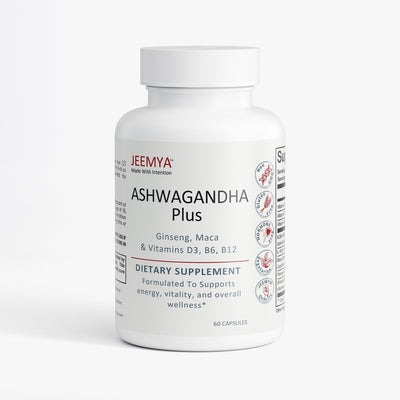
Jeemya Ashwagandha Plus: A Multi-Pathway Formula
Jeemya Ashwagandha Plus doesn't rely on ashwagandha alone. It combines KSM-66 at a full 600 mg clinical dose with complementary ingredients that support the same systems through different mechanisms:
-
KSM-66® Ashwagandha (600 mg), HPA axis modulation, cortisol reduction, cognitive support
-
L-Arginine (300 mg), nitric oxide precursor supporting healthy circulation
-
Maca Root Powder (150 mg), traditional adaptogen for stamina and hormonal balance
-
Panax Ginseng (100 mg), energy and cognitive performance support
-
Shatavari (50 mg), Ayurvedic adaptogen for vitality and hormonal harmony
-
Vitamin D3 (20 mcg), immune function, mood regulation, and bone health
-
Vitamin B6 (2.5 mg), neurotransmitter synthesis (serotonin, dopamine, GABA)
-
Vitamin B12 (25 mcg), energy metabolism and nervous system support
This multi-pathway approach means the formula supports stress response, energy, circulation, and neural function simultaneously — rather than relying on a single compound for all outcomes.
Adapt. Don't just endure.
→ Explore Jeemya Ashwagandha Plus
Frequently Asked Questions
How long does ashwagandha take to work?
Most clinical trials show measurable cortisol reduction within 30 days, with full benefits emerging at 8–12 weeks of consistent use. Some people report subjective improvements in stress and sleep within 2 weeks.
Can I take ashwagandha every day?
Clinical trials have demonstrated safety with daily use for up to 3 months. Long-term safety data beyond 3 months is limited. Consult your healthcare provider for extended use.
Does ashwagandha make you sleepy?
Ashwagandha is not a sedative. It supports sleep by lowering cortisol — the hormone that keeps you alert. Most users report improved sleep quality without daytime drowsiness.
What's the difference between KSM-66 and other ashwagandha?
KSM-66 is a patented, full-spectrum root extract standardized to ≥5% withanolides, backed by more published clinical trials than any other ashwagandha extract. Generic ashwagandha powders may contain inconsistent withanolide levels.
Can ashwagandha increase testosterone?
Clinical trials show KSM-66 at 600 mg/day can increase total testosterone within the normal healthy range in men, particularly when combined with resistance training. Effects on testosterone in women have not been significant.
Is ashwagandha safe with other supplements?
Ashwagandha is generally well-tolerated alongside most supplements. However, consult your healthcare provider if you take thyroid medication, immunosuppressants, sedatives, or diabetes medications.
References
-
Lopresti, A.L., et al. (2019). An investigation into the stress-relieving and pharmacological actions of an ashwagandha extract. Medicine, 98(37), e17186.
-
BJPsych Open (2025). Effects of Ashwagandha Supplements on Cortisol, Stress, and Anxiety Levels in Adults: A Systematic Review and Meta-Analysis. Volume 11, Supplement S1.
-
Langade, D., et al. (2019). Efficacy and Safety of Ashwagandha Root Extract on Sleep Quality in Adults. Cureus, 11(9), e5797.
-
Wankhede, S., et al. (2015). Examining the effect of KSM-66 on muscle strength and recovery. Journal of the International Society of Sports Nutrition, 12, 43.
-
NIH Office of Dietary Supplements (2026). Ashwagandha — Health Professional Fact Sheet.
-
Bonilla, D.A., et al. (2023). Effects of Withania somnifera on Cortisol Levels in Stressed Adults. Nutrients, 15(24), 5035.
-
Zahiruddin, S., et al. (2024). Ashwagandha's Multifaceted Effects on Human Health. International Journal of Molecular Sciences.
These statements have not been evaluated by the Food and Drug Administration. This product is not intended to diagnose, treat, cure, or prevent any disease. Always consult your healthcare provider before starting any new supplement regimen.