Your colon processes roughly 10 tonnes of food over the course of a decade. It absorbs water, electrolytes, and nutrients from digested material while moving waste toward elimination. When this system runs efficiently, you don't think about it. When it doesn't, bloating, irregularity, discomfort, sluggishness, it affects everything from energy levels to mood.
A gentle colon cleanse isn't a dramatic intervention. It's a support system: providing the fiber, enzymes, and botanical extracts that help your digestive tract do what it's designed to do, move material through efficiently, break it down completely, and maintain the mucosal environment that keeps the entire process comfortable.
This article explains how colon cleansing actually works at the physiological level, which ingredients are backed by research, and why "gentle" matters more than "aggressive."
How Your Colon Actually Works
Before understanding what a cleanse does, it's worth understanding what the colon does on its own.
The Three Core Functions
1. Water & Electrolyte Absorption The colon reabsorbs approximately 1.5 litres of water daily from digested material. This is why dehydration often causes constipation, there isn't enough water left in the colon to keep stool soft and mobile.
2. Peristalsis (Movement) Smooth muscle contractions called peristalsis move material through the colon at a controlled rate. When peristalsis slows - due to low fiber intake, dehydration, stress, or medication side effects - transit time increases. Longer transit time means more water absorption, harder stools, and irregularity.
3. Microbial Ecosystem Your colon hosts trillions of bacteria - the gut microbiome. These organisms ferment undigested fiber, produce short-chain fatty acids (SCFAs) that nourish colon cells, synthesize certain vitamins, and regulate immune function. A healthy colon depends on a healthy microbial balance.
What Goes Wrong
The modern Western diet averages 15 g of fiber per day - roughly half the recommended 25–30 g. Low fiber means less bulk to stimulate peristalsis, less prebiotic fuel for beneficial bacteria, and slower transit times. Add chronic stress (which directly slows gut motility via the vagus nerve), sedentary lifestyles, and processed food, and the result is a colon operating well below its capacity.
Why "Gentle" Matters
Not all colon cleanses are equal. Aggressive stimulant laxatives (senna, cascara sagrada) work by irritating the colon wall, forcing contractions. They produce rapid results, but at a cost: cramping, electrolyte imbalance, dependency with long-term use, and potential damage to the colonic nerve plexus.
A gentle colon cleanse takes a fundamentally different approach. Instead of forcing the colon into action through irritation, it provides the raw materials, fiber, enzymes, and motility-supporting botanicals, that allow the colon to function optimally on its own terms.
The distinction matters. Stimulant laxatives override the system. Gentle cleansing supports it.
The Four Pillars of Gentle Digestive Support
Every effective gentle cleanse targets one or more of these systems:
1. Bulk Formation (Fiber)
Soluble fiber absorbs water and forms a gel-like mass that adds bulk to stool. More bulk stretches the colon wall, which triggers natural peristaltic contractions. This is the colon's own mechanism, fiber simply gives it the material to work with.
2. Enzymatic Breakdown
Digestive enzymes break down food components that might otherwise reach the colon partially undigested, causing gas, bloating, and discomfort. Complete upstream digestion means less fermentation burden on the colon.
3. Motility Support
Certain botanical compounds - particularly gingerols from ginger root - promote normal peristaltic rhythm without the irritant mechanism of stimulant laxatives. They work with the colon's smooth muscle, not against it.
4. Prebiotic Nourishment
Soluble fiber that reaches the colon intact becomes food for beneficial bacteria. This fermentation produces short-chain fatty acids (butyrate, propionate, acetate) that nourish colonocytes, maintain mucosal integrity, and support a balanced microbial environment.
Ingredient 1: Psyllium Husk (Plantago ovata)
Pillar: Bulk Formation + Prebiotic Nourishment
What It Is
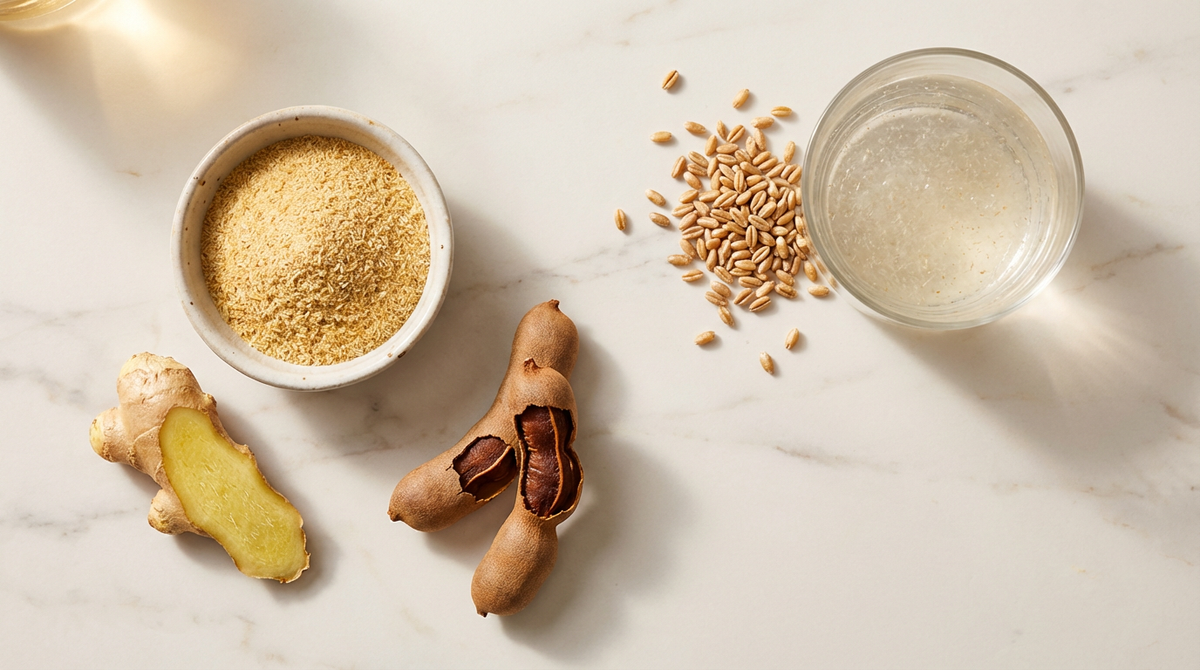
Psyllium husk is the outer coating of seeds from Plantago ovata, a plant native to India. It's one of the most clinically studied fiber sources in the world, and one of the few fibers that qualifies as both soluble and viscous, giving it unique properties in the digestive tract.
How It Works in the Body
Gel Formation & Bulk When psyllium contacts water, it absorbs up to 10 times its weight and forms a viscous gel. This gel adds volume and moisture to stool, making it softer and easier to pass. The increased bulk stretches the colon wall, activating stretch receptors that trigger natural peristaltic contractions, the body's own motility mechanism.
Prebiotic Function Psyllium reaches the colon largely intact, where it's slowly fermented by beneficial bacteria. This fermentation produces short-chain fatty acids, particularly butyrate, the preferred energy source for colonocytes (the cells lining the colon). Butyrate supports mucosal barrier integrity, reduces inflammation, and promotes a healthy microbial balance.
Non-Irritant Mechanism Unlike stimulant laxatives, psyllium doesn't irritate the colon wall. It doesn't force contractions. It provides bulk, and the colon responds naturally. This makes it suitable for long-term use without dependency risk.
Key Research Findings
A systematic review by McRorie & McKeown (2017, Nutrition Today) confirmed psyllium is the only fiber with sufficient evidence to support claims for both cholesterol lowering and improved regularity. It consistently improves stool frequency and consistency in clinical trials.
Jalanka et al. (2019, Alimentary Pharmacology & Therapeutics) demonstrated that psyllium supplementation increased stool water content and accelerated colonic transit time in healthy volunteers.
Ingredient 2: Ginger Root Extract (Zingiber officinale)
Pillar: Motility Support
What It Is
Ginger root has been used medicinally for over 5,000 years. Its primary bioactive compounds - gingerols and shogaols - have documented effects on gastrointestinal motility, nausea, and inflammation.
How It Works in the Body
Prokinetic Action (Peristalsis Support) Gingerols interact with serotonin (5-HT) receptors in the gut wall, specifically 5-HT3 and 5-HT4 receptors. These serotonin receptors are key regulators of gut motility. By modulating these receptors, ginger promotes coordinated peristaltic contractions that move material through the digestive tract at a normal pace. This is a prokinetic effect, promoting movement without forcing it.
Anti-Nausea & Gastroprotective Ginger has well-documented antiemetic properties. It also supports the integrity of the gastric mucosa, the protective lining of the stomach and upper digestive tract.
Anti-Inflammatory Gingerols inhibit cyclooxygenase (COX) and lipoxygenase (LOX) pathways, the same inflammatory pathways targeted by NSAIDs, but through a gentler, botanical mechanism. This helps reduce gut inflammation that can impair motility and contribute to discomfort.
Key Research Finding
Nikkhah Bodagh et al. (2018, Food Science & Nutrition) reviewed 12 clinical trials and concluded that ginger significantly accelerates gastric emptying and stimulates antral contractions in both healthy subjects and patients with functional dyspepsia.
Ingredient 3: Tamarind Fruit Extract (Tamarindus indica)
Pillar: Motility Support + Prebiotic Nourishment
What It Is
Tamarind is a tropical fruit with a long history of use in traditional medicine across Asia and Africa. Its pulp contains tartaric acid, malic acid, polysaccharides, and pectin, all compounds with documented effects on digestive function.
How It Works in the Body
Natural Laxative Effect Tamarind pulp contains hydroxycitric acid and tartaric acid, which have a mild osmotic effect, drawing water into the intestinal lumen. This softens stool and supports easier passage without the cramping associated with stimulant laxatives.
Pectin & Polysaccharide Content The polysaccharides in tamarind act as soluble fiber, complementing psyllium's bulk-forming action. Pectin specifically supports the gel matrix that keeps stool at an optimal consistency.
Hepatoprotective Properties Traditional and preclinical research suggests tamarind extract supports liver function — relevant because the liver's bile production directly affects fat digestion and bowel regularity. Bile acts as a natural laxative in the colon.
Key Research Finding
Komakech et al. (2019, Evidence-Based Complementary and Alternative Medicine) reviewed the pharmacological properties of Tamarindus indica and confirmed its laxative, anti-inflammatory, and antimicrobial properties, supporting its traditional use in digestive health.
Ingredient 4: Digestive Enzyme Blend (from Fermented Cereals)
Pillar: Enzymatic Breakdown
What It Is
A multi-enzyme complex derived from fermented cereals, providing four key digestive enzymes: amylase, lactase, lipase, and cellulase.
How Each Enzyme Works
|
Enzyme |
Substrate |
Function |
|---|---|---|
|
Amylase |
Starches & carbohydrates |
Breaks down complex carbs into simple sugars for absorption |
|
Lactase |
Lactose (milk sugar) |
Converts lactose into glucose and galactose — prevents lactose-related bloating |
|
Lipase |
Fats & lipids |
Breaks down dietary fats into fatty acids and glycerol for absorption |
|
Cellulase |
Plant cell walls (cellulose) |
Breaks down indigestible plant fiber into smaller fragments — humans don't produce this enzyme naturally |
Why This Matters for Colon Health When food isn't fully digested in the stomach and small intestine, the undigested material reaches the colon where bacteria ferment it. Incomplete digestion of carbohydrates produces excess gas (hydrogen, methane). Undigested fats can cause steatorrhea and discomfort. Undigested lactose causes osmotic diarrhea in lactose-intolerant individuals.
By supporting complete upstream digestion, these enzymes reduce the fermentation burden on the colon, meaning less gas, less bloating, and a more comfortable digestive experience.
Fermented Cereal Source These enzymes are derived from fermented cereals rather than animal sources (porcine pancreatin), making them suitable for vegetarian and vegan diets while maintaining effective enzyme activity across a broad pH range.
How All Four Ingredients Work Together
|
Digestive Need |
Problem |
Colon Gentle Cleanse Solution |
|---|---|---|
|
Regularity |
Low fiber, insufficient bulk |
Psyllium Husk (gel formation, stretch-receptor activation) |
|
Comfortable Motility |
Slow peristalsis, sluggish transit |
Ginger Root (5-HT receptor modulation, prokinetic action) |
|
Stool Consistency |
Hard, dry stools |
Psyllium (water absorption) + Tamarind (osmotic softening) |
|
Reduced Bloating |
Incomplete digestion, excess fermentation |
Enzyme Blend (amylase, lactase, lipase, cellulase) |
|
Microbiome Support |
Low prebiotic intake |
Psyllium + Tamarind polysaccharides (SCFA production) |
|
Gut Comfort |
Inflammation, mucosal irritation |
Ginger (COX/LOX inhibition) + Psyllium (butyrate production) |
This isn't a single-mechanism approach. It's an integrated digestive architecture, each ingredient addressing a different bottleneck in the colon's performance chain.
Who Benefits Most from Gentle Colon Support
-
Anyone eating less than 25 g of fiber daily: which includes the majority of adults in Western countries
-
People experiencing occasional irregularity: whether from travel, stress, dietary changes, or medication side effects
-
Those with sensitive digestion: who react poorly to stimulant laxatives (cramping, urgency, dependency)
-
Individuals prone to bloating: from incomplete carbohydrate or lactose digestion
-
Anyone seeking a natural daily maintenance approach: rather than reactive intervention
Safety & Usage
Jeemya Colon Gentle Cleanse uses naturally occurring fibers, botanical extracts, and plant-derived enzymes at established dosages.
Dosage: 1 sachet mixed into 6.76 oz (200 ml) of non-carbonated water. Stir well and drink immediately. A possible increase in consistency to a jelly-like mass is normal and does not affect quality. Frequency: Once or twice daily, separate from meals. Timing: Take at least 2 hours after any medication. Hydration: Adequate water intake (2+ litres daily) is essential when supplementing with psyllium, fiber requires water to form gel and function properly.
Consult your healthcare provider if you: take medications (especially within 2 hours of dosing); are pregnant or nursing; have inflammatory bowel disease or bowel obstruction; are under 12 years of age.
Frequently Asked Questions: a viscous gel, this is the same gel that adds bulk and moisture in your colon. Drink the
What does psyllium husk actually do in the colon?
Psyllium absorbs up to 10 times its weight in water, forming a viscous gel that adds bulk and moisture to stool. This bulk triggers the colon's natural peristaltic contractions, promoting regularity without irritation. It also feeds beneficial gut bacteria, producing short-chain fatty acids that nourish colon cells.
Is this a laxative?
Not in the traditional sense. Stimulant laxatives irritate the colon wall to force contractions. Colon Gentle Cleanse works by providing fiber (for natural bulk), enzymes (for complete digestion), and ginger (for prokinetic support). It works with your colon's own mechanisms, not against them.
How fast does it work?
Most users notice improved regularity within 24–72 hours of consistent use. Psyllium's effects build with daily use as fiber intake normalizes and the gut microbiome adapts.
Can I take it long-term?
Yes. Unlike stimulant laxatives, psyllium-based fiber supplements are safe and appropriate for ongoing daily use. There is no dependency risk. The digestive enzymes and ginger are similarly safe for extended use at these dosages.
Why does it form a jelly when mixed with water?
That's the psyllium doing its job. When psyllium contacts water, it formmixture promptly after stirring to avoid excess thickening.
The Bottom Line
Colon Gentle Cleanse delivers digestive support across four simultaneous pillars:
-
Bulk formation: Psyllium Husk (soluble fiber, stretch-receptor activation)
-
Motility support: Ginger Root (prokinetic, 5-HT receptor modulation)
-
Stool softening: Tamarind Extract (osmotic effect, pectin polysaccharides)
-
Enzymatic completeness: Amylase, Lactase, Lipase, Cellulase (upstream digestion)
Gentle works. Aggressive breaks.
→ Try Jeemya Colon Gentle Cleanse
References
-
McRorie, J.W. & McKeown, N.M. (2017). Understanding the physics of functional fibers in the gastrointestinal tract. Nutrition Today, 52(2), 82–89.
-
Jalanka, J., et al. (2019). The effect of psyllium husk on intestinal microbiota in constipated patients and healthy controls. Alimentary Pharmacology & Therapeutics, 49(4), 416–427.
-
Nikkhah Bodagh, M., et al. (2018). Ginger in gastrointestinal disorders: A systematic review of clinical trials. Food Science & Nutrition, 7(1), 96–108.
-
Komakech, R., et al. (2019). A comprehensive review of Tamarindus indica in traditional and modern medicine. Evidence-Based Complementary and Alternative Medicine.
-
Ianiro, G., et al. (2016). Digestive enzyme supplementation in gastrointestinal diseases. Current Drug Metabolism, 17(2), 187–193.
These statements have not been evaluated by the Food and Drug Administration. This product is not intended to diagnose, treat, cure, or prevent any disease. Always consult your healthcare provider before starting any new supplement regimen.