Your brain consumes 20% of your body's total energy, despite being only 2% of your body weight. It runs on a precise balance of neurotransmitters, blood flow, oxygen delivery, and cellular energy production. When any of these systems falters, the result is familiar: brain fog, poor concentration, sluggish memory, mental fatigue.
Nootropics are compounds designed to support these systems. Not by forcing the brain into overdrive, but by providing the raw materials, cofactors, and signaling support it needs to function at its natural capacity.
This article explains what nootropics are, how they work at the neurochemical level, which ingredients are backed by research, and who they're designed for.
What Are Nootropics?
The term "nootropic" was coined in 1972 by Romanian psychologist Corneliu Giurgea. He defined it as any substance that enhances learning and memory, protects the brain from physical or chemical injury, and has very few side effects.
Today, the term encompasses a broad category of compounds - from amino acids and B vitamins to botanical extracts and phospholipids - that support cognitive function through different neurochemical pathways.
Nootropics are not stimulants. Caffeine forces alertness by blocking adenosine receptors. Nootropics work differently, they support the brain's own production of neurotransmitters, protect neurons from oxidative damage, and improve cerebral blood flow.
How Nootropics Work: The Four Pathways
Every effective nootropic targets one or more of these four systems:
1. Neurotransmitter Support
Your brain communicates through chemical messengers, acetylcholine (learning and memory), dopamine (motivation and reward), serotonin (mood), and GABA (calm and focus). Nootropics can:
-
Provide precursors for neurotransmitter synthesis (e.g., choline → acetylcholine)
-
Inhibit enzymes that break down neurotransmitters (e.g., Huperzine A inhibits acetylcholinesterase)
-
Directly modulate receptor activity (e.g., GABA on GABA-A receptors)
2. Cerebral Blood Flow
Your brain needs constant oxygen and glucose delivery. Compounds like grape seed extract and green tea extract contain polyphenols that support vasodilation and microcirculation in the brain's capillary network.
3. Neuroprotection
Oxidative stress damages neurons over time, a process accelerated by chronic stress, poor sleep, and aging. Antioxidant nootropics (vitamins C and E, selenium, grape seed extract) neutralize reactive oxygen species before they damage cell membranes and DNA.
4. Cellular Energy Production
Neurons are among the most energy-demanding cells in the body. B vitamins serve as essential cofactors in the mitochondrial energy production chain. Without adequate B1, B2, B3, B5, B6, B12, and folate, your neurons literally cannot produce enough ATP to fire efficiently.
Key Nootropic Ingredients: What the Research Shows
DMAE (Dimethylaminoethanol)
DMAE is a naturally occurring compound that serves as a precursor to acetylcholine, the neurotransmitter most directly involved in learning, memory formation, and sustained attention. By supporting acetylcholine synthesis, DMAE provides the raw material your brain needs for focused cognitive work.
Bacopa Monnieri Extract
Bacopa is one of the most clinically studied botanical nootropics. A 2014 meta-analysis of 9 randomized, placebo-controlled studies (518 total participants) found that Bacopa significantly improves attention and decreases reaction time. Research also shows Bacopa enhances memory acquisition, delayed recall, and retention of new information, meaning you learn faster and forget slower. Effects typically build over 4–8 weeks of consistent use.
Phosphatidylserine
A phospholipid that forms a critical part of every cell membrane in your brain. Studies show that as little as 100 mg can improve memory in people with memory complaints. Phosphatidylserine also helps with cognitive processing, mood regulation, and stress resilience, it's been shown to blunt cortisol spikes during mental stress.
GABA (Gamma-Aminobutyric Acid)
The brain's primary inhibitory neurotransmitter. GABA counterbalances excitatory neurotransmitters like glutamate, preventing neural overactivation. When GABA levels are adequate, you experience calm focus rather than anxious mental racing. Supplemental GABA supports relaxation without sedation, allowing you to concentrate without the mental noise.
Huperzine A
Extracted from Chinese club moss (Huperzia serrata), Huperzine A is a potent, selective inhibitor of acetylcholinesterase, the enzyme that breaks down acetylcholine. By slowing this breakdown, Huperzine A keeps acetylcholine levels elevated in the synaptic cleft for longer, extending the duration of memory encoding and focused attention.
Green Tea Extract
Contains both L-theanine and catechin polyphenols (especially EGCG). L-theanine promotes alpha brain wave activity, the neural state associated with relaxed alertness. EGCG acts as a potent antioxidant, protecting neurons from oxidative damage while supporting cerebral blood flow.
DHA (Docosahexaenoic Acid)
An omega-3 fatty acid that constitutes approximately 40% of the polyunsaturated fatty acids in the brain. DHA is structurally essential for neuronal membranes and synaptic function. Adequate DHA supports signal transmission speed, membrane fluidity, and long-term brain health.
Glutamic Acid & L-Glutamine
Glutamic acid is the most abundant excitatory neurotransmitter in the brain. L-Glutamine serves as its precursor. Together, they support the glutamate-GABA balance, the fundamental excitation/inhibition cycle that governs all cognitive processing.
The Vitamin & Mineral Foundation
Nootropic compounds can only work if the brain's basic nutritional infrastructure is in place. Deficiencies in key vitamins and minerals are one of the most common - and overlooked - causes of brain fog:
|
Nutrient |
Role in Brain Function |
|---|---|
|
Vitamin B1 (Thiamine) |
Essential for glucose metabolism in neurons — your brain's primary fuel |
|
Vitamin B6 |
Required cofactor for serotonin, dopamine, and GABA synthesis |
|
Vitamin B12 |
Maintains myelin sheath integrity for fast neural signal transmission |
|
Folate |
DNA synthesis and repair in rapidly dividing brain cells; reduces homocysteine |
|
Vitamin C |
Antioxidant protection; cofactor for norepinephrine synthesis |
|
Vitamin E |
Protects neuronal cell membranes from lipid peroxidation |
|
Vitamin D |
Receptors in mood-regulating brain regions; supports immune function |
|
Magnesium |
Involved in 300+ enzymatic reactions; regulates NMDA receptors |
|
Zinc |
Modulates synaptic transmission; concentrated in hippocampus (memory center) |
|
Selenium |
Antioxidant enzyme cofactor; protects against age-related cognitive decline |
|
Iron |
Oxygen transport to brain tissue via hemoglobin |
An estimated 42% of American adults are deficient in vitamin D alone. B12 deficiency affects up to 15% of older adults. These deficiencies directly impair cognitive function regardless of any nootropic compounds you take.
Who Benefits Most from Nootropic Support?
-
Knowledge workers and professionals who need sustained focus, mental clarity, and resistance to cognitive fatigue during long work days
-
Students preparing for exams or managing heavy course loads, Bacopa and phosphatidylserine specifically support memory acquisition and retention
-
Adults 40+ experiencing age-related changes in memory, processing speed, or mental sharpness
-
High-stress individuals whose cortisol levels are impairing focus and memory consolidation
-
Anyone experiencing brain fog from nutrient deficiencies, poor sleep, or chronic mental fatigue
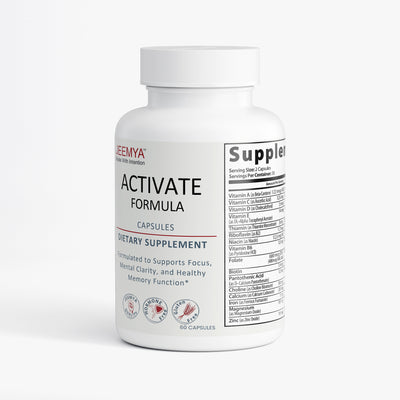
Jeemya ACTIVATE FORMULA: A Complete Cognitive Architecture
Jeemya ACTIVATE FORMULA is built on the principle that cognitive performance depends on multiple systems working simultaneously. Rather than isolating a single compound, it combines:
Neurotransmitter Support:
-
DMAE Bitartrate: acetylcholine precursor
-
Huperzine A: acetylcholinesterase inhibitor (keeps acetylcholine active longer)
-
GABA: inhibitory neurotransmitter for calm focus
-
Phosphatidylserine: cell membrane support and cortisol modulation
-
Choline Bitartrate: additional acetylcholine substrate
Botanical Nootropics:
-
Bacopa Extract: memory, attention, and processing speed
-
Green Tea Extract: L-theanine for alpha waves + EGCG antioxidant protection
-
Bilberry Fruit Extract: cerebral microcirculation support
Neuroprotective Antioxidants:
-
Grape Seed Extract: powerful polyphenol antioxidant
-
Vitamin C (125 mg), Vitamin E (14 mg), Selenium (50 mcg)
Essential Brain Fuel:
-
Complete B-complex (B1, B2, B3, B5, B6, B12, Folate, Biotin)
-
DHA (14%): structural omega-3 for neuronal membranes
-
Magnesium, Zinc, Iron, Potassium
Additional Support:
-
Inositol: secondary messenger in neurotransmitter signaling
-
L-Glutamine HCL and Glutamic Acid: excitatory neurotransmitter support
This multi-pathway architecture means ACTIVATE FORMULA addresses cognition from raw material supply, through neurotransmitter production, to synaptic protection, rather than relying on a single mechanism.
Clarity isn't accidental. It's architectural.
→ Explore Jeemya ACTIVATE FORMULA
Frequently Asked Questions
How long do nootropics take to work? Some compounds (GABA, L-theanine) produce effects within 30–60 minutes. Others (Bacopa, phosphatidylserine) require 4–8 weeks of consistent daily use to show measurable cognitive improvements.
Are nootropics safe? Well-studied nootropic compounds at established dosages have strong safety profiles. B vitamins, amino acids, and phospholipids are naturally occurring nutrients. Botanical extracts like Bacopa and Huperzine A have been used in traditional medicine for centuries with minimal side effects.
Can I take nootropics with coffee? Yes. Green tea extract contains L-theanine, which actually smooths out caffeine's effects, reducing jitteriness while preserving alertness. Most nootropic ingredients are compatible with moderate caffeine consumption.
What's the difference between nootropics and stimulants? Stimulants (caffeine, amphetamines) force alertness by overriding your brain's natural signaling. Nootropics support the brain's own chemistry, providing building blocks, protecting neurons, and optimizing neurotransmitter balance. No crash, no dependency cycle.
Who shouldn't take nootropics? Pregnant or nursing women, children under 18, and individuals on psychiatric medications or blood thinners should consult a healthcare provider before use. People with seizure disorders should be cautious with compounds that affect GABA or glutamate signaling.
References
-
Giurgea, C. (1972). The nootropic concept. Drug Development Research.
-
Kongkeaw, C., et al. (2014). Meta-analysis of Bacopa monnieri on cognition. Journal of Ethnopharmacology, 151(1), 528–535.
-
Glade, M.J. & Smith, K. (2015). Phosphatidylserine and the human brain. Nutrition, 31(6), 781–786.
-
NIH Office of Dietary Supplements — Vitamin B12, Vitamin D, Folate Fact Sheets (2026).
-
Innerbody Research (2026). Best Nootropics: Boost Focus, Memory, and Learning.
These statements have not been evaluated by the Food and Drug Administration. This product is not intended to diagnose, treat, cure, or prevent any disease. Always consult your healthcare provider before starting any new supplement regimen.